

Bacteriosis
Bacterial Stain
Xanthomonas Hortorum Pv. Pelargonii
Pathogen:
Bacterium
Type:
Risk to the plant:
INTERMEDIATE


DESCRIPTION
WHO CAUSES IT?
Bacterial spot, caused by the bacteria Xanthomonas hortorum, is a common disease that affects geraniums and other ornamental plants. This bacteria is pathogenic for a wide range of hosts and can cause significant damage under favorable conditions.
SYMPTOMS
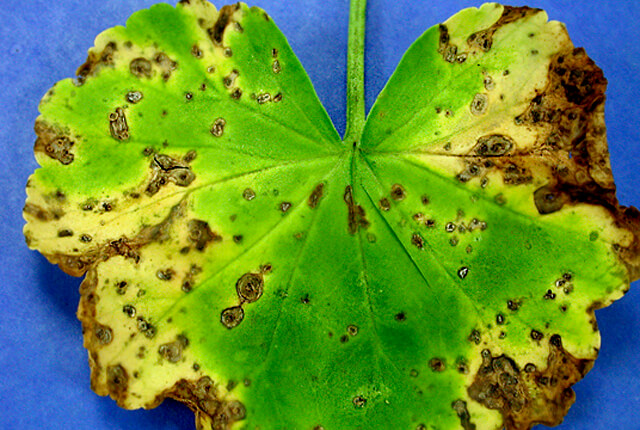
Bacterial spot is characterized by the formation of small necrotic lesions on the leaves, stems and flowers of the plant. These lesions usually have a yellow or brown center surrounded by a yellowish halo, giving the disease its characteristic appearance. As the disease progresses, the lesions can fuse and cause premature defoliation of the plant, weakening it and affecting its growth and flowering.



TEMPERATURE AND HUMIDITY
25°C - 30°C
70% - 90%

HOW IS IT SPREAD?
Direct contact, transport by irrigation water.

HOW TO REMOVE IT?
Home remedies
There are no home treatments
Chemical treatments
• COPPER OXYCHLORIDE 35% (exp. in Cu) [WG] P/P
• CUPROUS OXIDE 50% (EXPR. IN CU) [WP] P/P
• CUPROUS OXIDE 50% (EXPR. IN CU) [WP] P/P
• CUPROCALCIC SULFATE 20% (EXPR. IN CU) [WG] P/P
Authorized treatments in organic farming
• COPPER OXYCHLORIDE 35% (exp. in Cu) [WG] P/P
• CUPROUS OXIDE 50% (EXPR. IN CU) [WP] P/P
• CUPROUS OXIDE 50% (EXPR. IN CU) [WP] P/P
• CUPROCALCIC SULFATE 20% (EXPR. IN CU) [WG] P/P
Insect allies
PREDATORY MITES
LADYBUGS
LACEWINGS
PARASITIC WASPS
HOVERFLIES OR PARASITIC FLIES
PREDATORY BUGS
There are no natural allies
Mycodiplosis oidii (predatory mosquito)
EFFECTIVE PRODUCTS TO ELIMINATE THIS DISEASE
Sponsored link

Sponsored link


Sponsored link
Sponsored link
Sponsored link


Sponsored link
Sponsored link
Effective against all types of fungi

Sponsored link


Sponsored link
Sponsored link

Sponsored link


Sponsored link
To prevent the appearance of bacterial spot on geranium, it is important to maintain good hygiene in the garden or in the environment where the plant is grown. It is recommended to avoid overhead irrigation, which can promote the spread of the bacteria, and use irrigation techniques that avoid wetting the leaves and stems of the plant. In addition, it is important to regularly remove disease-affected plant parts and avoid over-fertilizing, which can weaken the plant's resistance to disease.
Recommendations

Enjoy idMicrobe TOTALLY FREE, with no trial periods.


