

Escarabajos
Swiss chard flea beetle: what it is, how it originates, and how to eliminate it effectively
Swiss Chard Flea
Chaetocnema Tibialis
Pathogen:
Insect
Type:
Risk to the plant:
INTERMEDIATE


DESCRIPTION
WHO CAUSES IT?
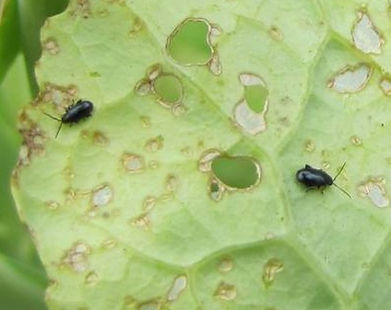
Chaetocnema tibialis, commonly known as the chard flea, is a small beetle of the family Chrysomelidae. This insect goes through four main stages of development: egg, larva, pupa and adult. Adults are small, shiny black, and have the ability to jump, giving them their common name. Females lay their eggs in the soil near host plants. The larvae emerge from the eggs and feed on the underground roots and stems of plants. After several weeks, the larvae pupate in the soil, later emerging as adults. Adults feed mainly on leaves, leaving characteristic small holes. In temperate climates, Chaetocnema tibialis can have several generations per year, which facilitates its rapid proliferation and continuous damage to chard crops.
SYMPTOMS
In chard, infestation by Chaetocnema tibialis causes a disease known as chard flea. This pathogen affects both young seedlings and adult plants, causing significant damage to the leaves and, in severe cases, the roots. Foliar damage is particularly problematic as it reduces the photosynthetic capacity of the plant and can render the leaves unsuitable for sale or consumption.
• Small irregular holes in the leaves.
• Leaves with a sifted appearance.
• Reduction in photosynthetic capacity.
• Weakened seedlings with slow growth.
• Damage to roots and underground stems.
• Loss of general vigor in the plant.


TEMPERATURE AND HUMIDITY
20ºC - 30ºC
40% - 60%

HOW IS IT SPREAD?
Wind, direct contact between plants, soil movement, gardening tools.

HOW TO REMOVE IT?
Home remedies
There are no home treatments
Chemical treatments
• DELTAMETHRIN 2.5% [EW] P/V
• LAMBDA CYHALOTHRIN 10% [CS] P/V
• TEFLUTRIN 0.5% [GR] P/P
Authorized treatments in organic farming
• LAMBDA CYHALOTHRIN 10% [CS] P/V
Insect allies
PREDATORY MITES
LADYBUGS
LACEWINGS
PARASITIC WASPS
HOVERFLIES OR PARASITIC FLIES
PREDATORY BUGS
There are no natural allies
Mycodiplosis oidii (predatory mosquito)
EFFECTIVE PRODUCTS TO ELIMINATE THIS DISEASE
Sponsored link
Sponsored link


Sponsored link
Sponsored link
Sponsored link


Sponsored link
Sponsored link
Effective against all types of fungi

Sponsored link


Sponsored link
Sponsored link

Sponsored link


Sponsored link
• Carry out crop rotations to interrupt the beetle's life cycle.
• Maintain cleanliness of the field, eliminating crop remains and weeds that could serve as shelter for adults.
• Implement physical barriers such as mesh or covers to protect young seedlings.
• Use sticky traps to monitor and reduce the adult population.
• Encourage the presence of natural enemies, such as parasitoid wasps and insectivorous birds.
• Apply biological insecticides based on Bacillus thuringiensis or neem in early stages of infestation.
• Apply chemical insecticides as a last measure, following local recommendations and rotating products to avoid the development of resistance.
• Maintain adequate watering to strengthen plants and make them less susceptible to damage.
Recommendations

Enjoy idMicrobe TOTALLY FREE, with no trial periods.


