

Micosis/Hongos
Rhinchosporiosis
Rhynchosporium Secalis
Pathogen:
Fungus
Type:
Risk to the plant:
HIGH

DESCRIPTION
WHO CAUSES IT?
Rhynchosporium secalis is a fungal pathogen that affects winter cereals, causing an important foliar disease known as rhynchosporiosis. This fungus has a great capacity to survive in the plant remains of previous crops and can persist in the soil for long periods in unfavorable conditions. Its spores are dispersed mainly by water splashes and wind during rains, which facilitates its spread within the crop. Under favorable conditions, the spores germinate and penetrate the leaf cuticle through natural openings or small wounds. Once inside the leaf, the fungus grows intercellularly, forming visible lesions on the surface of the leaves. These lesions produce new spores, which can initiate new infections if conditions are right. Furthermore, Rhynchosporium secalis is capable of producing resistance spores (chlamydospores) that allow it to survive during the winter months and thus restart the infectious cycle in the following growing season.
SYMPTOMS
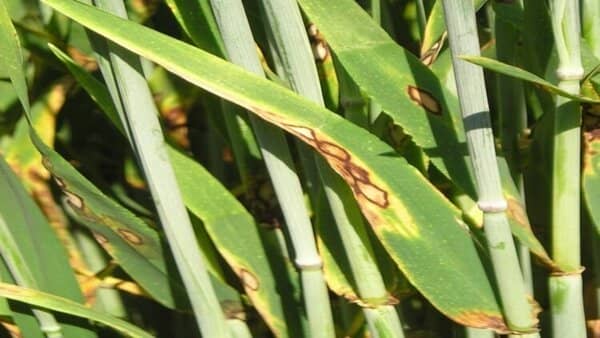
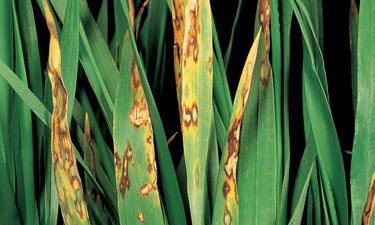
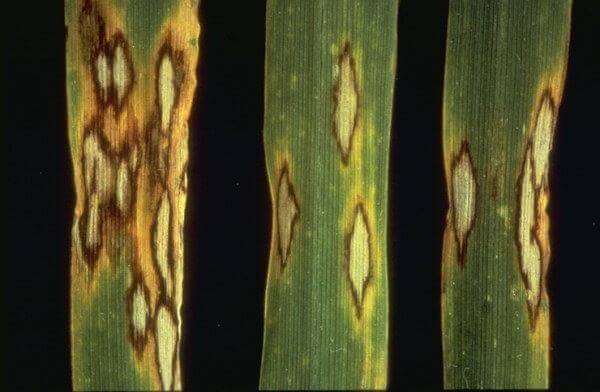
Rhynchosporiosis caused by Rhynchosporium secalis severely affects winter cereals, weakening the plants and significantly reducing crop yield. The first symptoms usually appear as small necrotic Taches on older leaves, which then expand, forming larger, grayish or brown lesions. As the disease progresses, these lesions can coalesce, covering large portions of the leaf, limiting the photosynthetic capacity of the plant. In severe cases, the fungus can also affect the spike, compromising grain production and quality.
- Necrotic Taches on leaves, gray to brown in color
- Elongated lesions that expand and coalesce
- Loss of photosynthetic capacity
- Affectation of the spike and loss of quality in the grains
- Withering and necrosis of older leaves
- Significant decrease in crop yield


TEMPERATURE AND HUMIDITY
10°C - 20°C
85% - 100%

HOW IS IT SPREAD?
Spores carried by water splashes, wind, infected crop remains, contaminated seeds

HOW TO REMOVE IT?
Home remedies
There are no home treatments
Chemical treatments
• AZOXISTROBIN 12% + TEBUCONAZOLE 20% [SC] P/V
• AZOXISTROBIN 20% + TEBUCONAZOLE 20% [SC] P/V
• AZOXISTROBIN 25% [SC] P/V
• BENZOVINDIFLUPYR 10% [EC] P/V
• BIXAFEN 7.5% + PROTHIOCONAZOLE 15% [EC] P/V
• BIXAFEN 7.5% + SPIROXAMINE 15% + TRIFLOXISTROBIN 10% [EC] P/V
• FENPICOXAMID 5% + PROTHIOCONAZOLE 10% [EC] P/V
• FLUXAPYROXAD 33.3% [FS] P/V
• FLUXAPYROXAD 5% + MEFENTRIFLUCONAZOLE 10% [EC] P/V
• FLUXAPYROXAD 6.25% [EC] P/V
• FLUXAPYROXAD 62.5g/L + METCONAZOLE 45g/L [EC] P/V
• FLUXAPYROXAD 7.5% + PIRACLOSTROBIN 15% [EC] P/V
• METCONAZOLE 9% [EC] P/V
• PIRACLOSTROBIN 25% [EC] P/V
• PROTHIOCONAZOLE 12.5% + TEBUCONAZOLE 12.5% [EC] P/V
• PROTHIOCONAZOLE 15% + BENZOVINDIFLUPYR 7.5% [EC] P/V
• PROTHIOCONAZOLE 25% [EC] P/V
• TEBUCONAZOLE 20% [EW] P/V
• TEBUCONAZOLE 25% [EW] P/V
• TEBUCONAZOLE 25% [WG] P/P
• TEBUCONAZOLE 43% [SC] P/V
Authorized treatments in organic farming
-
Insect allies
PREDATORY MITES
LADYBUGS
LACEWINGS
PARASITIC WASPS
HOVERFLIES OR PARASITIC FLIES
PREDATORY BUGS
There are no natural allies
Mycodiplosis oidii (predatory mosquito)
EFFECTIVE PRODUCTS TO ELIMINATE THIS DISEASE
Sponsored link
Sponsored link


Sponsored link
Sponsored link
Sponsored link


Sponsored link
Sponsored link
Effective against all types of fungi

Sponsored link


Sponsored link
Sponsored link

Sponsored link


Sponsored link
- Use cereal varieties resistant or tolerant to Rhynchosporium secalis, reducing susceptibility to infection.
- Practice crop rotation with species that are not hosts of the pathogen to avoid the accumulation of inoculum in the field.
- Maintain good aeration in the crop through adequate sowing, which will help reduce relative humidity and stop the development of the fungus.
- Apply fungicides preventively or in the early stages of infection, especially in situations where climatic conditions favor the development of the fungus.
- Eliminate harvest remains from previous crops, as these can serve as a reservoir for the fungus and facilitate reinfection in the following season.
- Reduce sprinkler irrigation in areas where the pathogen is present, since splashing water can favor the spread of spores.
- Regularly monitor crops to detect the first signs of the disease and apply phytosanitary treatments in time.
Recommendations

Enjoy idMicrobe TOTALLY FREE, with no trial periods.


