

Royas
Orange Rust
Phragmidium Rubi-Idaei
Pathogen:
Fungus
Type:
Risk to the plant:
HIGH

DESCRIPTION
WHO CAUSES IT?
Phragmidium rubi-idaei is a basidiomycete fungus that causes orange rust on raspberries. This pathogen has a complex life cycle involving several stages of sporulation and different types of spores. It begins with the production of urediniospore spores, which are spread by the wind and infect the leaves of the raspberry. Urediniospores germinate in conditions of high humidity and moderate temperatures, forming hyphae that penetrate the leaf tissue. As the infection progresses, teliospore spores form, allowing the fungus to survive over the winter. In the spring, these teliospores germinate and produce basidiospores, which in turn restart the cycle by infecting new plants. This process of sporulation and germination allows the pathogen to spread rapidly and maintain its presence in the agricultural environment.
SYMPTOMS
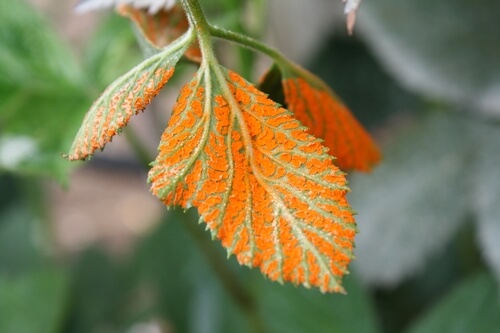
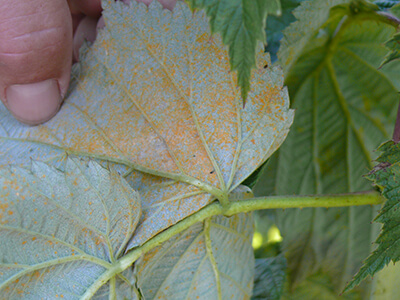
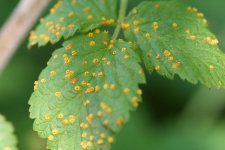
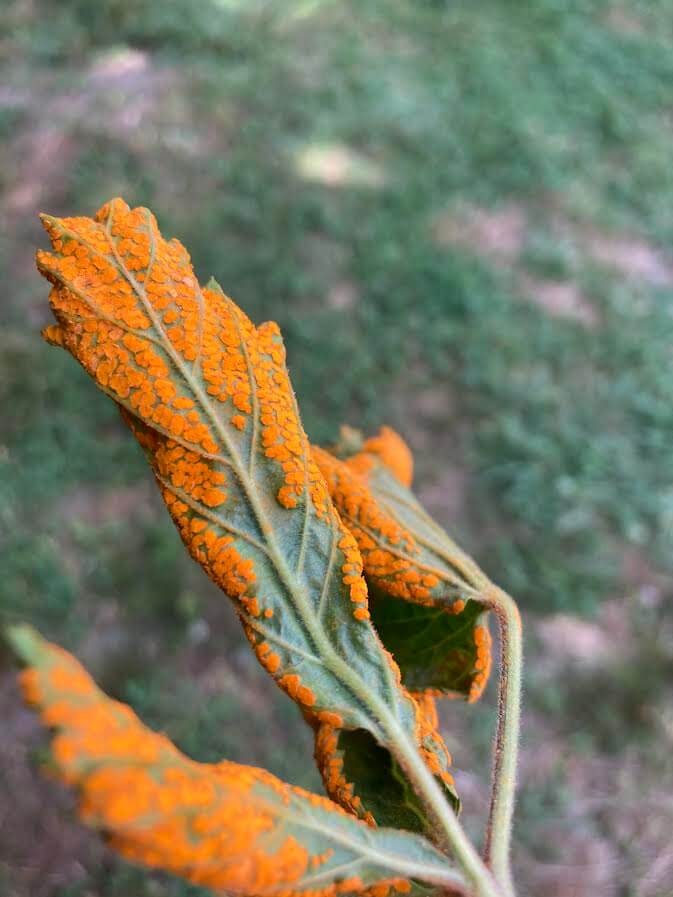
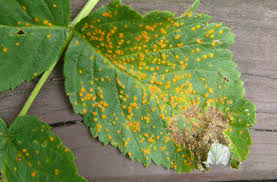
Orange rust in raspberries, caused by Phragmidium rubi-idaei, appears mainly on the leaves and occasionally on the stems and fruits. The disease reduces photosynthesis and plant vitality, affecting its growth and yield. Symptoms begin with small yellow Taches on the upper surface of the leaves, which expand and become orange pustules on the underside. As the disease progresses, leaves may become chlorotic and drop prematurely, weakening the plant and decreasing its ability to produce fruit.
- Yellow Taches on the upper surface of the leaves.
- Orange pustules on the underside of the leaves.
- Leaf chlorosis.
- Premature defoliation.
- General weakening of the plant.
- Reduction in fruit production.

TEMPERATURE AND HUMIDITY
15°C - 25°C
80% - 100%

HOW IS IT SPREAD?
Wind, irrigation water, rain splashes, infected plant remains, contaminated tools, vector insects

HOW TO REMOVE IT?
Home remedies
There are no home treatments
Chemical treatments
• ORANGE OIL 60g/L [ME] P/S
• AZOXISTROBIN 25% [SC] P/V
• DIFENOCONAZOLE 25% [EC] P/V
• PIRACLOSTROBIN 6.7% + BOSCALIDE 26.7% ( ) [WG] P/P
• EUGENOL 3.3% + GERANIOL 6.6% + THYMOL 6.6% [CS] P/V
Authorized treatments in organic farming
• ORANGE OIL 60g/L [ME] P/S
• EUGENOL 3.3% + GERANIOL 6.6% + THYMOL 6.6% [CS] P/V
Insect allies
PREDATORY MITES
LADYBUGS
LACEWINGS
PARASITIC WASPS
HOVERFLIES OR PARASITIC FLIES
PREDATORY BUGS
There are no natural allies
Mycodiplosis oidii (predatory mosquito)
EFFECTIVE PRODUCTS TO ELIMINATE THIS DISEASE
Sponsored link

Sponsored link


Sponsored link
Sponsored link
Sponsored link


Sponsored link
Sponsored link
Effective against all types of fungi

Sponsored link


Sponsored link
Sponsored link

Sponsored link


Sponsored link
- Use cultivars resistant to orange rust.
- Implement a proper crop rotation, avoiding planting raspberries in the same areas year after year.
- Improve ventilation in the field through regular pruning and removal of dense vegetation.
- Avoid overhead irrigation, especially at night, to reduce humidity on the leaves.
- Apply preventive and curative fungicides following technical recommendations and treatment thresholds.
- Eliminate and destroy infected plant remains to reduce the inoculum of the fungus in the field.
- Constantly monitor the crop to detect early symptoms of the disease and act quickly.
- Maintain adequate space between plants to improve air circulation and reduce leaf humidity.
- Disinfect work tools and equipment to prevent the spread of the fungus between plants and plots.
Recommendations

Enjoy idMicrobe TOTALLY FREE, with no trial periods.


