

Mosquito verde
Green leafhopper
Empoasca vitis
Pathogen:
Insect
Type:
Risk to the plant:
HIGH

DESCRIPTION
WHO CAUSES IT?
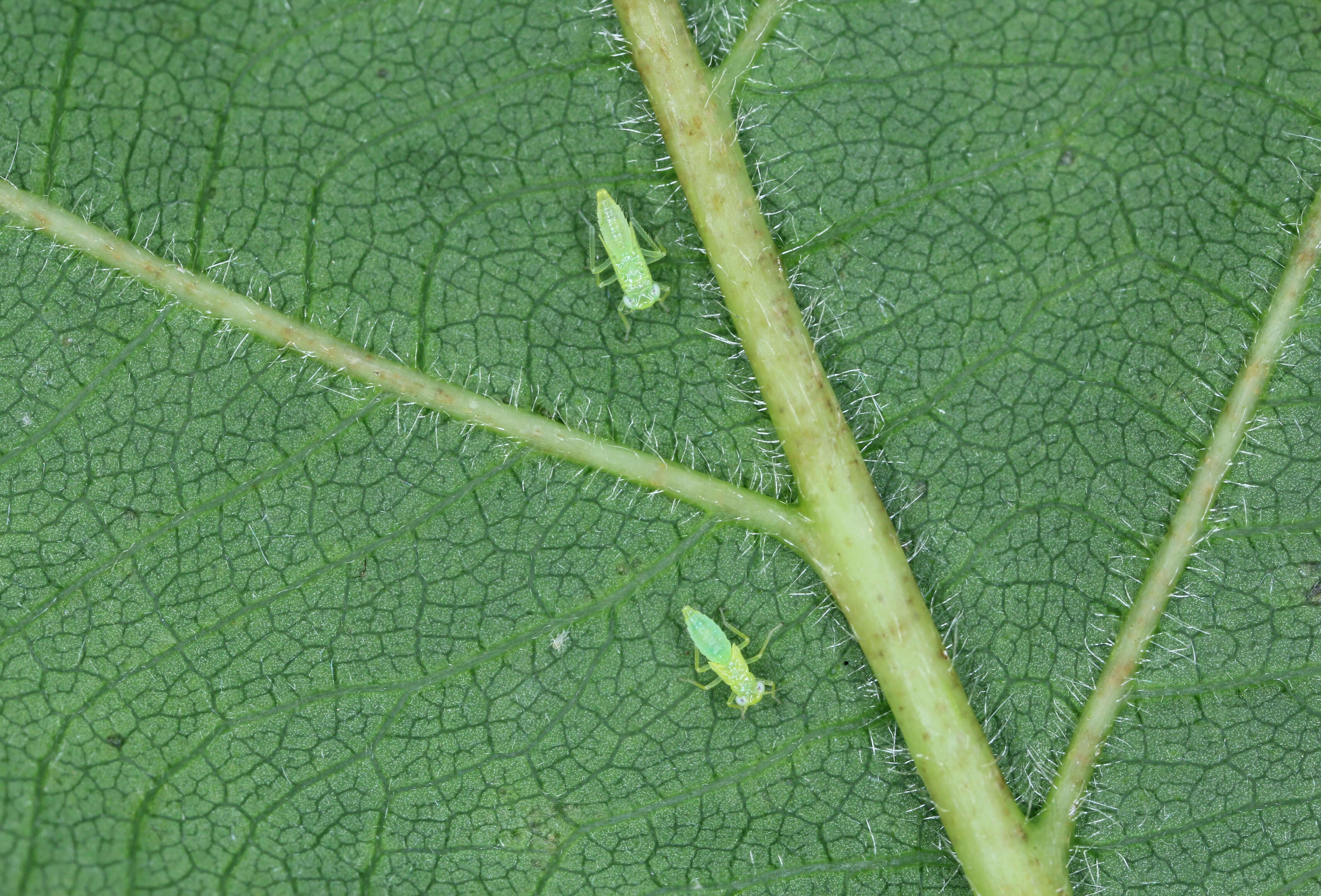
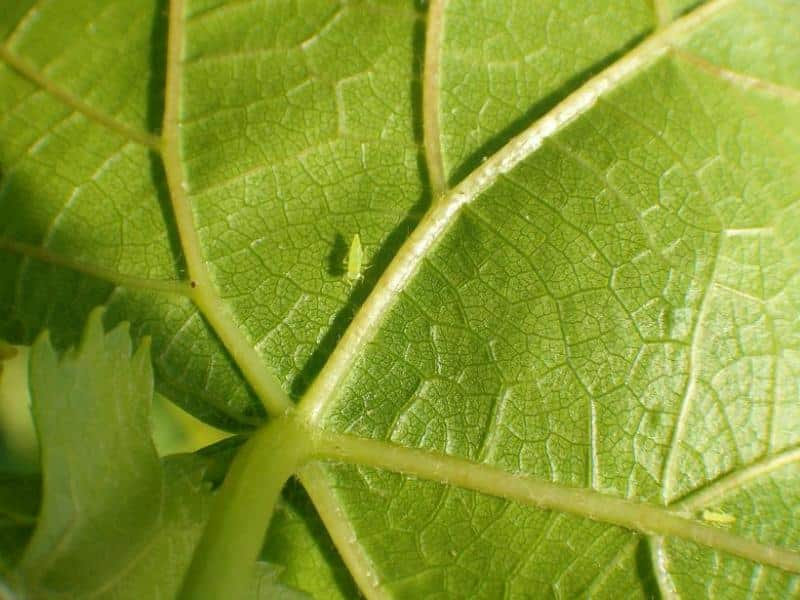
Empoasca vitis, commonly known as the green mosquito, is a small insect belonging to the Cicadellidae family. This pest is especially active during warm seasons and is characterized by its high mobility and colonization capacity. Adults have an elongated body, bright green, and have membranous wings that allow them to move quickly from one plant to another. After mating, females insert their eggs into tender plant tissues, preferably on the underside of young leaves. The nymphs emerge and go through several molts before reaching the adult stage. During its nymphal and adult phase, Empoasca vitis feeds on the phloem of the leaves, introducing its chopping-sucking mouthparts to suck sap. This feeding activity not only weakens the plants, but also causes significant physiological alteration. Generations follow one another quickly under favorable conditions, and can be completed in a few weeks. Furthermore, it is capable of hibernating as an adult in nearby spontaneous vegetation or in plant remains, which ensures its persistence in the agricultural environment.
SYMPTOMS
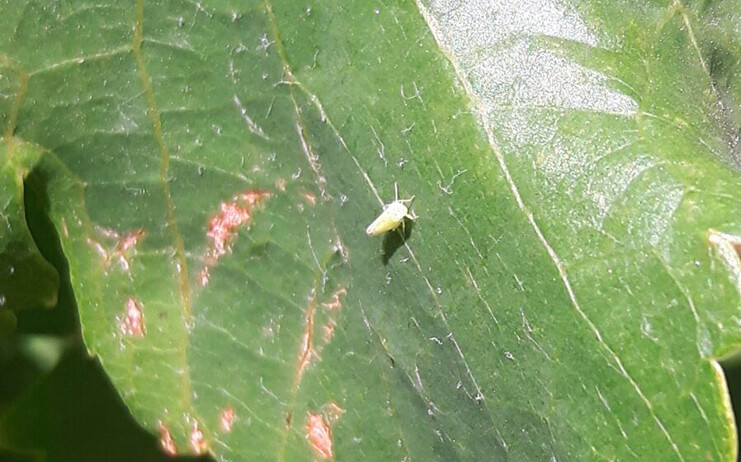
The green mosquito directly affects plants through its continuous feeding on young leaves, which triggers a series of physiological alterations known as phytotoxicity due to their bite. These alterations include the interruption of nutrient transport and the appearance of marginal chlorosis, reducing the photosynthetic capacity of the plant. Prolonged infestation can lead to general weakening of the plant, loss of vigor and a considerable decrease in yield.
- Downward curling of the edges of the leaves
- Progressive yellowing from the margins
- Stopping the growth of young shoots
- Marginal necrosis in adult leaves
- Presence of whitish spots due to bites
- Appearance of dry or burnt leaves
- Premature fall of affected leaves


TEMPERATURE AND HUMIDITY
20 °C – 30 °C
60 % – 80 %

HOW IS IT SPREAD?
Wind, Movements of infested plants, Contact between plants, Contaminated tools, Spontaneous vegetation

HOW TO REMOVE IT?
Home remedies
There are no home treatments
Chemical treatments
• ABAMECTIN 0.0015% + PYRETHRINS 0.02% [AL] P/V
• RAPE OIL 0.825% + PYRETHRINS 0.018% [AL] P/V
• RAPE OIL 82.53% + PYRETHRINS 0.459% [EC] P/V
• RAPE OIL 848.24 g/l [EC] P/V
• ORANGE OIL 6% [SL] P/V
• ORANGE OIL 60g/L [ME] P/V
• ACETAMIPRID 0.005% [AL] P/V
• ACETAMIPRID 20% [SP] P/P
• AZADIRACTIN 1% (AS AZADIRACTIN A) [EC] P/V
• Azadirachtin 2.6% (AS AZADIRACTIN A) [EC] P/V
• CYPERMETHRIN 10% [EC] P/V
• CYPERMETHRIN 5% [EC] P/V
• CYPERMETHRIN 50% [EC] P/V
• DELTAMETHRIN 1.5% [EW] P/V
• DELTAMETHRIN 1.57% [SC] P/V
• DELTAMETHRIN 10% [EC] P/V
• DELTAMETHRIN 2.5% [EC] P/V
• DELTAMETHRIN 2.5% [EW] P/V
• PHENPIROXIMATE 5.12% [SC] P/V
• FLUPIRADIFURONE 0.008% [AL] P/V
• FLUPYRADIFURONE 20% [SL] P/V
• LAMBDA CYHALOTHRIN 0.0015% [ME] P/V
• LAMBDA CYHALOTHRIN 10% [CS] W/V
• PYRETHRINS 4.65% (as pyrethrum extract) [EC] W/V
• PYRETHRINS 4% (PYRETHRUM EXTRACT) [EC] W/V
• POTASSIUM SALTS OF C14-C20 FATTY ACIDS 48% [EW] W/V
• TAU-FLUVALINATE 24% [EW] W/V
Authorized treatments in organic farming
• RAPE OIL 0.825% + PYRETHRINS 0.018% [AL] P/V
• RAPE OIL 82.53% + PYRETHRINS 0.459% [EC] P/V
• RAPE OIL 848.24 g/l [EC] P/V
• ORANGE OIL 6% [SL] P/V
• ORANGE OIL 60g/L [ME] P/V
• AZADIRACTIN 1% (AS AZADIRACTIN A) [EC] P/V
• Azadirachtin 2.6% (AS AZADIRACTIN A) [EC] P/V
• LAMBDA CYHALOTHRIN 0.0015% [ME] P/V
• LAMBDA CYHALOTHRIN 10% [CS] P/V
• PYRETHRINS 4.65% (as extract of Pyrethrum) [EC] W/V
• Pyrethrins 4% (Pyrethrum Extract) [EC] W/V
• Potassium Salts of C14-C20 Fatty Acids 48% [EW] W/V
Insect allies
PREDATORY MITES
LADYBUGS
LACEWINGS
PARASITIC WASPS
HOVERFLIES OR PARASITIC FLIES
PREDATORY BUGS
There are no natural allies
Mycodiplosis oidii (predatory mosquito)
EFFECTIVE PRODUCTS TO ELIMINATE THIS DISEASE
Sponsored link
Sponsored link


Sponsored link
Sponsored link
Sponsored link


Sponsored link
Sponsored link
Effective against all types of fungi

Sponsored link


Sponsored link
Sponsored link

Sponsored link


Sponsored link
- Eliminate weeds and nearby spontaneous vegetation that act as a refuge or reservoir for the insect.
- Use yellow adhesive chromatic traps to monitor the presence of adults and anticipate possible outbreaks.
- Promote biodiversity in the environment through hedges or associated crops that favor natural enemies such as lacewings or hoverflies.
- Apply phytosanitary treatments in the early stages of pest development, prioritizing selective products that are respectful of auxiliary fauna.
- Alternate active materials between applications to reduce selection pressure and minimize the risk of resistance.
- Carry out pruning that improves the ventilation of the crop and makes it difficult for the pest to settle.
- Avoid excessive use of nitrogen fertilizers, as they promote the growth of tender tissues that are very attractive to the pest.
- Schedule adequate irrigation to keep the plant in good physiological condition and reduce the impact of the attack.
- Remove and destroy severely affected leaves to stop the local expansion of the insect.
Recommendations

Enjoy idMicrobe TOTALLY FREE, with no trial periods.


