


Mildiu
Mildew: what it is, how it originates, and how to eliminate it effectively
Mildew
Bremia Lactucae
Pathogen:
Oomycete
Type:
Risk to the plant:
HIGH

DESCRIPTION
WHO CAUSES IT?
Bremia lactucae is a pathogenic oomycete that belongs to the mildew group. It is an obligate parasite that requires a living plant to complete its biological cycle. Its cycle begins when asexual spores, called sporangia, are released from reproductive structures on the surface of infected leaves. These spores are dispersed primarily by wind or rain, and when they land on a susceptible plant like lettuce, they germinate and produce germ tubes that penetrate the tissues through the stomata. The pathogen develops inside the plant, forming hyphae that branch within the mesophyll and produce new asexual spores on the external leaves, facilitating continued dissemination. During unfavorable conditions, *Bremia lactucae* can form oospores, resistance structures that allow its survival in soil or plant remains until conditions are favorable again.
SYMPTOMS
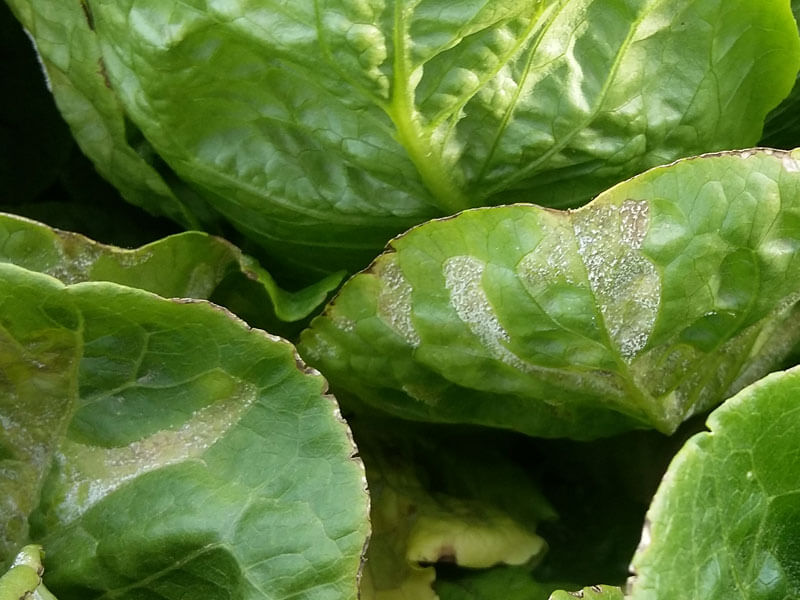
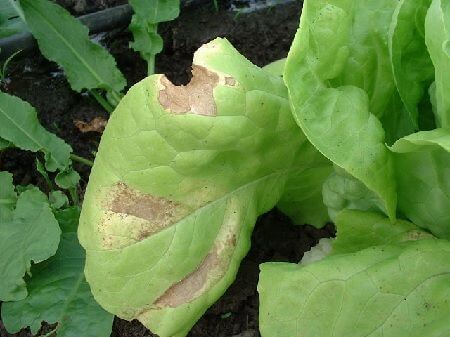
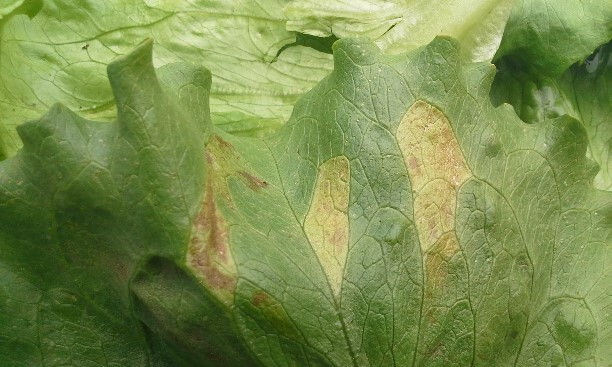
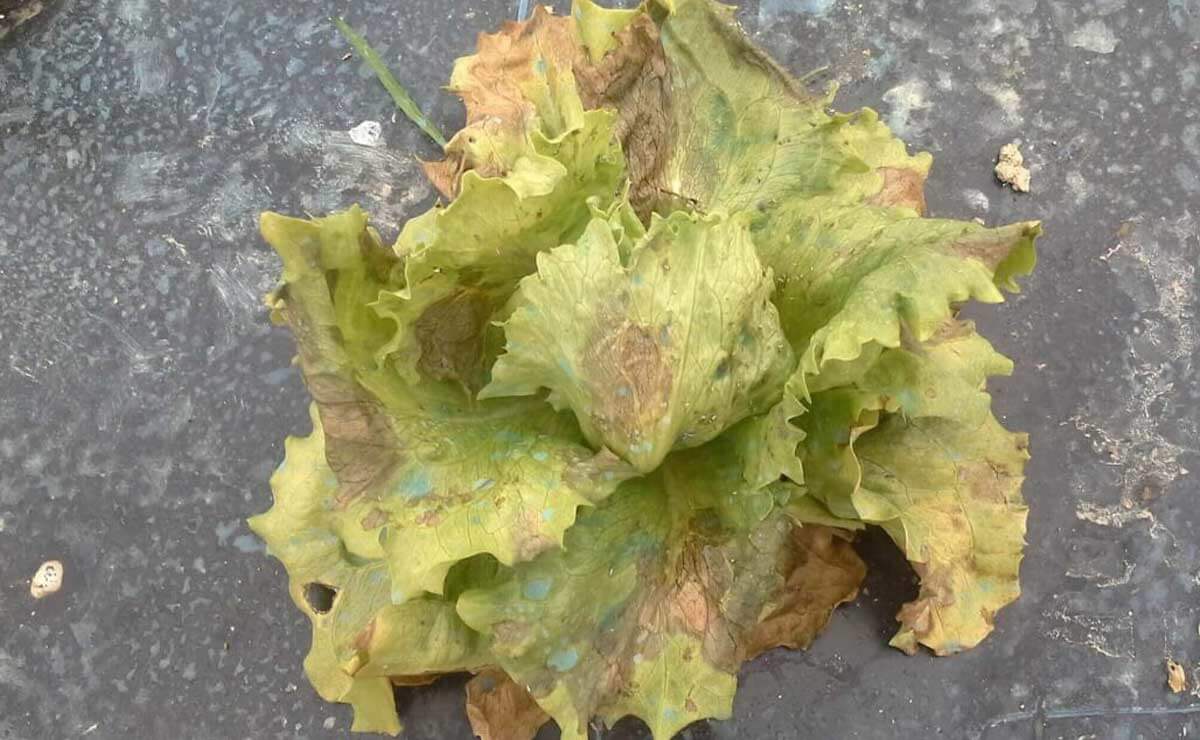
Downy mildew caused by Bremia lactucae is a devastating disease for crops such as lettuce, often manifesting itself in the form of chlorotic lesions on the leaves. Initially, the infection appears as small yellowish Taches that eventually become necrotic, which affects the growth and quality of the crop. Severely infected plants may experience stunted growth or even die if the infection is not controlled.
- Angular chlorotic Taches on the leaves.
- Appearance of white mold on the underside of the leaves, especially in high humidity conditions.
- Brown lesions that develop as the disease progresses.
- Wilting in young plants or those with severe infections.
- Defoliation in severe cases, which significantly reduces crop yield.


TEMPERATURE AND HUMIDITY
10-20°C
85-100%

HOW IS IT SPREAD?
Wind, rain, infected plant debris, contaminated tools, overhead irrigation

HOW TO REMOVE IT?
Home remedies
There are no home treatments
Chemical treatments
• ORANGE OIL 60g/L [ME] P/S
• AMETOCTRADIN 12% + METIRAM 44% [WG] P/P
• AMETOCTRADIN 20% [SC] P/V
• AMISULBROM 20% [SC] P/V
• AZOXISTROBIN 20% + DIFENOCONAZOLE 12.5% [SC] P/V
• AZOXISTROBIN 25% [SC] P/V
• CYMOXANIL 2.85% + FOSETIL-AL 30% + COPPER OXYCHLORIDE 16% (EXPR. IN CU) [WG] P/P
• CYMOXANILE 4% + FOLPET 25% + FOSETIL-AL 50% [WP] P/P
• CYMOXANIL 45% [WG] P/P
• CYMOXANILE 60% [WG] P/P
• FOSETIL 31% + Propamocarb 53% [SL] P/V
• FOSETIL-AL 80% [WG] P/P
• FOSETIL-AL 80% [WP] P/P
• POTASSIUM PHOSPHONATES 51% (Exp. as phosphorous acid) [SL] P/V
• CUPRIC HYDROXIDE 20% (EXPR. IN CU) [WG] P/P
• CUPRIC HYDROXIDE 25% (EXPR. IN CU) [WG] P/P
• CUPRIC HYDROXIDE 36% (EXPR. IN CU) [SC] P/V
• CUPRIC HYDROXIDE 50% (EXPR. IN CU) [WG] P/P
• CUPRIC HYDROXIDE 50% (EXPR. IN CU) [WP] P/P
• LAMINARIN 4.5% [SL] P/S
• MANDIPROPAMID 25% [SC] P/V
• MANDIPROPAMID 25% + OXATIAPIPROLIN 3% [SC] P/V
• METALAXIL 25% [WP] P/P
• METIRAM 70% [WG] P/P
• OXATIAPIPROLIN 10% [OD] P/V
• COPPER OXYCHLORIDE (Exp. in Cu) 52% [SC] P/V
• COPPER OXYCHLORIDE 14% (exp. in Cu) + CUPRIC HYDROXIDE 14% (exp. in Cu) [WG] P/P
• COPPER OXYCHLORIDE 30% (EXPR. IN CU) [WP] P/P
• COPPER OXYCHLORIDE 35% (exp. in Cu) [WG] P/P
• COPPER OXYCHLORIDE 35% (EXPR. IN CU) [WG] P/P
• COPPER OXYCHLORIDE 37.5% (EXPR. IN CU) [WG] P/P
• COPPER OXYCHLORIDE 38% (EXPR. IN CU) [SC] P/V
• COPPER OXYCHLORIDE 50% (EXPR. IN CU) [WG] P/P
• COPPER OXYCHLORIDE 50% (EXPR. IN CU) [WP] P/P
• COPPER OXYCHLORIDE 52% (EXPR. IN CU) [SC] P/V
• COPPER OXYCHLORIDE 70% (EXPR. IN CU) [SC] P/V
• CUPROUS OXIDE 50% (EXPR. IN CU) [WP] P/P
• CUPROUS OXIDE 75% (EXPR. IN CU) [WG] P/P
• PROPAMOCARB 52.5% (HYDROCHLORIDE) + FLUOPICOLIDE 6.25% [SC] P/V
• PROPAMOCARB 60.5% (c. hydrochloride) [SL] P/V
• CUPROCALCIC SULFATE 12.4% (EXPR. IN CU) [SC] P/V
• CUPROCALCIC SULFATE 20% (EXPR. IN CU) [WG] P/P
• CUPROCALCIC SULFATE 20% (EXPR. IN CU) [WP] P/P
• CUPROCALCIC SULFATE 20% (EXPR. IN CU) [WG] P/P
• CUPROCALCIC SULFATE 20% [WP] P/P
• TRIBASIC COPPER SULFATE 19% (EXPR. IN CU) [SC] P/V
• TRIBASIC COPPER SULFATE 40% (EXPR. IN CU) [WG] P/P
Authorized treatments in organic farming
• ORANGE OIL 60g/L [ME] P/S
• CUPRIC HYDROXIDE 20% (EXPR. IN CU) [WG] P/P
• CUPRIC HYDROXIDE 25% (EXPR. IN CU) [WG] P/P
• CUPRIC HYDROXIDE 36% (EXPR. IN CU) [SC] P/V
• CUPRIC HYDROXIDE 50% (EXPR. IN CU) [WG] P/P
• CUPRIC HYDROXIDE 50% (EXPR. IN CU) [WP] P/P
• LAMINARIN 4.5% [SL] P/S
• COPPER OXYCHLORIDE (Exp. in Cu) 52% [SC] P/V
• COPPER OXYCHLORIDE 14% (exp. in Cu) + CUPRIC HYDROXIDE 14% (exp. in Cu) [WG] P/P
• COPPER OXYCHLORIDE 30% (EXPR. IN CU) [WP] P/P
• COPPER OXYCHLORIDE 35% (exp. in Cu) [WG] P/P
• COPPER OXYCHLORIDE 35% (EXPR. IN CU) [WG] P/P
• COPPER OXYCHLORIDE 37.5% (EXPR. IN CU) [WG] P/P
• COPPER OXYCHLORIDE 38% (EXPR. IN CU) [SC] P/V
• COPPER OXYCHLORIDE 50% (EXPR. IN CU) [WG] P/P
• COPPER OXYCHLORIDE 50% (EXPR. IN CU) [WP] P/P
• COPPER OXYCHLORIDE 52% (EXPR. IN CU) [SC] P/V
• COPPER OXYCHLORIDE 70% (EXPR. IN CU) [SC] P/V
• CUPROUS OXIDE 50% (EXPR. IN CU) [WP] P/P
• CUPROUS OXIDE 75% (EXPR. IN CU) [WG] P/P
• CUPROCALCIC SULFATE 12.4% (EXPR. IN CU) [SC] P/V
• CUPROCALCIC SULFATE 20% (EXPR. IN CU) [WG] P/P
• CUPROCALCIC SULFATE 20% (EXPR. IN CU) [WP] P/P
• CUPROCALCIC SULFATE 20% (EXPR. IN CU) [WG] P/P
• CUPROCALCIC SULFATE 20% [WP] P/P
• TRIBASIC COPPER SULFATE 19% (EXPR. IN CU) [SC] P/V
• TRIBASIC COPPER SULFATE 40% (EXPR. IN CU) [WG] P/P
Insect allies
PREDATORY MITES
LADYBUGS
LACEWINGS
PARASITIC WASPS
HOVERFLIES OR PARASITIC FLIES
PREDATORY BUGS
There are no natural allies
Mycodiplosis oidii (predatory mosquito)
EFFECTIVE PRODUCTS TO ELIMINATE THIS DISEASE





- Use mildew-resistant lettuce varieties, selecting those that have been specifically developed to resist *Bremia lactucae* infections.
- Practice crop rotation, avoiding planting lettuce in the same place consecutively, to reduce the presence of oospores in the soil.
- Implement biological control measures that involve the use of natural antagonists that limit the proliferation of the pathogen.
- Keep the foliage dry, avoiding overhead irrigation and favoring drip irrigation to reduce humidity on the surface of the leaves.
- Apply specific fungicides according to technical recommendations for mildew control, alternating products with different modes of action to avoid the development of resistance.
- Remove and destroy the remains of infected crops immediately after harvest to reduce the reservoir of spores in the environment.
- Constantly monitor weather conditions and the state of the crop to apply preventive treatments at key moments.
- Control humidity inside the greenhouses, ensuring adequate ventilation to prevent condensation and reduce favorable conditions for the development of mildew.
Recommendations



Explore more tools
Services
Contact
Legal
©2023 por ZeriMar Laboratoire. Todos os direitos reservados.