

Ácaros
Spidermites
Spidermites
Pathogen:
Insect
Type:
Risk to the plant:
HIGH

DESCRIPTION
WHO CAUSES IT?
Mites are microscopic arthropods belonging to the class Arachnida and the order Acari. There are many phytophagous species that feed on the cellular content of plants, such as Tetranychus urticae (red spider), Polyphagotarsonemus latus (bud mite) or Brevipalpus spp. Their small size, rapid reproduction and ability to adapt make them one of the most persistent pests in various crops. Adults usually have four pairs of legs and an oval body, and reproduce by laying eggs on the underside of leaves or in protected areas of the foliage. Under favorable conditions, such as high temperatures and low humidity, development from egg to adult can be completed in less than a week. Females can lay dozens of eggs in a few days, leading to explosive populations. Immature forms go through larval and nymphal stages before reaching maturity. Many species survive in a dormant state during the winter in plant remains or crop structures, reinfesting the plants in spring.
SYMPTOMS
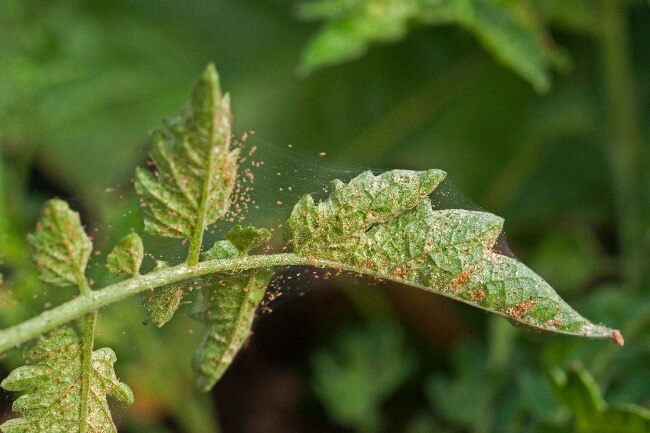
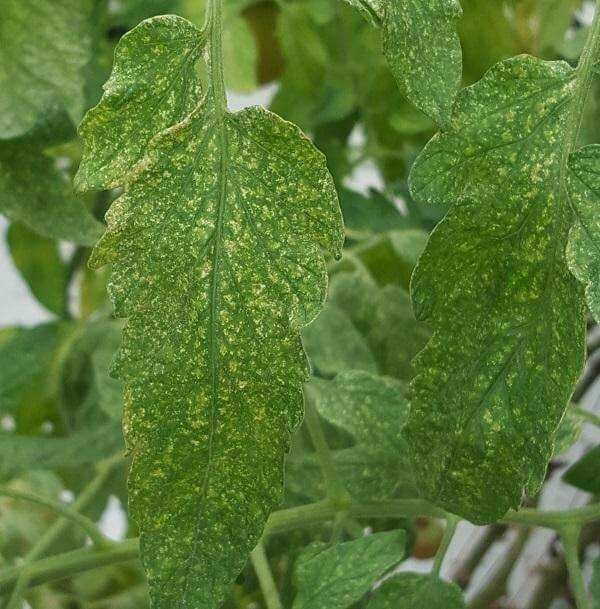
In plants, mites cause both direct damage through their feeding and indirect damage by promoting the entry of pathogens or weakening the plant. Its action causes deformations, loss of photosynthetic area, and a decrease in the general vigor of the plant. Some mites also inject toxins or cause localized necrosis, and their presence often goes unnoticed until the population is high.
- Discolorations on leaves (yellowing, tanning or silvering)
- Chlorotic spots distributed on the leaf surface
- Curling, wrinkling or deformation of new leaves
- Stopping growth or reducing the size of shoots
- Presence of fine cobwebs, especially in red spider infestations
- Premature fall of leaves, flowers or fruits
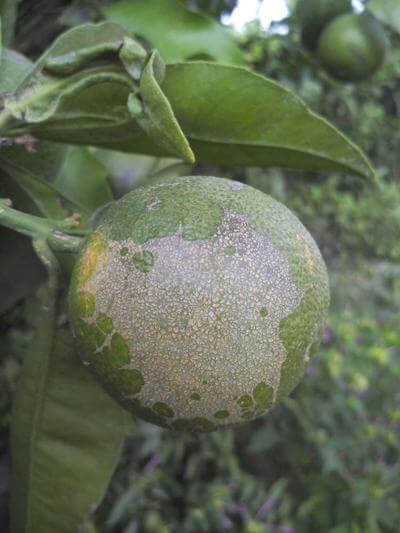
- Deformed fruits or fruits with rough and corky areas
- Visible damage to nerves or growth areas


TEMPERATURE AND HUMIDITY
22°C - 35°C
30% - 60%

HOW IS IT SPREAD?
Wind, Contact between plants, Contaminated tools, Work clothing, Plant remains, Infested plants

HOW TO REMOVE IT?
Home remedies
There are no home treatments
Chemical treatments
• ABAMECTIN 0.0015% + PYRETHRINS 0.02% [AL] P/V
• ABAMECTIN 1.8% [EC] P/V
• RAPE OIL 0.825% + PYRETHRINS 0.018% [AL] P/V
• RAPE OIL 1.69% ( ) [AL] P/V
• RAPE OIL 77.7% [EC] P/V
• RAPE OIL 82.53% + PYRETHRINS 0.459% [EC] P/V
• ORANGE OIL 60g/L [ME] P/V
• PARAFFIN OIL (CAS [97862-82-3]) 40% [EW] P/V
• ACETAMIPRID 0.005% [AL] P/V
• SULFUR 0.4% + Potassium salts of unsaturated fatty acids C7-C18 & C18 (CAS [67701-09-1] 1% [AL] W/V
• Sulfur 80% [SC] W/V
• Sulfur 80% [WG] W/W
• Sulfur 80% [WP] W/W
• Ethoxazole 11% [SC] W/V
• Aluminum phosphide 56% [GE] W/W
• Hexythiazox 10% [WP] W/W
• Hexythiazox 25.87% [SC] W/V
• Lambda cyhalothrin 10% [CS] W/V
• Potassium salts of C14-C20 fatty acids 48% [EW] W/V
• Potassium salts of fatty acids VEGETABLES 13.04% [SL] W/V
• TAU-FLUVALINATE 24% [EW] W/V
Treatments allowed in organic farming
• RAPE OIL 0.825% + PYRETHRINS 0.018% [AL] P/V
• RAPE OIL 1.69% ( ) [AL] P/V
• RAPE OIL 77.7% [EC] P/V
• RAPE OIL 82.53% + PYRETHRINS 0.459% [EC] P/V
• ORANGE OIL 60g/L [ME] P/V
• PARAFFIN OIL (CAS [97862-82-3]) 40% [EW] P/V
• SULFUR 0.4% + POTASSIUM SALTS OF UNSATURATED FATTY ACIDS C7-C18 & C18 (CAS [67701-09-1] 1% [AL] P/V
• SULFUR 80% [SC] P/V
• SULFUR 80% [WG] W/W
• SULFUR 80% [WP] W/W
• LAMBDA CYHALOTHRIN 10% [CS] W/V
• POTASSIUM SALTS OF C14-C20 FATTY ACIDS 48% [EW] W/V
• POTASSIUM SALTS OF VEGETABLE FATTY ACIDS 13.04% [SL] W/V
Insect allies
PREDATORY MITES
LADYBUGS
LACEWINGS
PARASITIC WASPS
HOVERFLIES OR PARASITIC FLIES
PREDATORY BUGS
There are no natural allies
Mycodiplosis oidii (predatory mosquito)
EFFECTIVE PRODUCTS TO ELIMINATE THIS DISEASE
Sponsored link
Sponsored link


Sponsored link
Sponsored link
Sponsored link


Sponsored link
Sponsored link
Effective against all types of fungi

Sponsored link


Sponsored link
Sponsored link

Sponsored link


Sponsored link
- Carry out frequent monitoring, especially in hot and dry conditions
- Use magnifying glasses or sticky traps to detect early populations
- Eliminate weeds and plant debris where mites can take refuge.
- Promote adequate environmental humidity in sensitive crops
- Avoid excess nitrogen that promotes more susceptible tender tissue.
- Introduce natural enemies such as predatory mites (Phytoseiulus persimilis, Amblyseius spp.)
- Alternate acaricidal products with different modes of action
- Use mineral or vegetable oils in the initial stages of the plague
- Apply localized treatments to reduce environmental impact and resistance
- Do not apply acaricides preventively without justification
- Keep tools clean to avoid dispersion
- Promote biodiversity in the crop environment to promote biological control
Recommendations

Enjoy idMicrobe TOTALLY FREE, with no trial periods.


