

Oídio
Powdery Mildew
Sphaerotheca Pannosa / Podosphaera Tridactyla
Pathogen:
Fungus
Type:
Risk to the plant:
INTERMEDIATE


DESCRIPTION
WHO CAUSES IT?
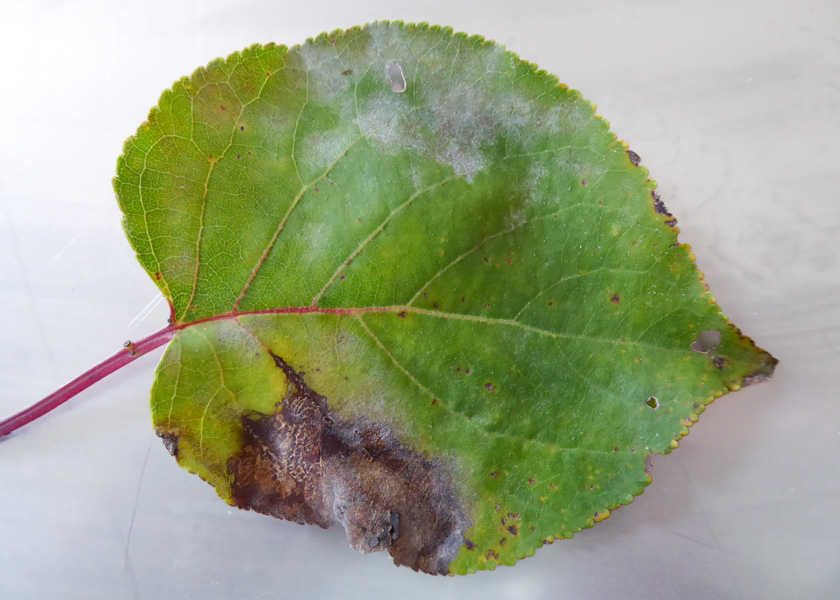
Sphaerotheca pannosa and Podosphaera tridactyla are two species of fungi that cause the disease known as powdery mildew on a variety of plants, including apricot (Prunus armeniaca). These pathogens are responsible for causing white, powdery-looking Taches on the leaves, stems and fruits of apricot trees, which negatively affects their health and yield.
SYMPTOMS
Powdery mildew disease in apricot initially manifests itself as white, powdery-looking Taches on the upper part of the leaves, which can then spread to the stems and fruits. As the disease progresses, these Taches can merge and cover large areas of the plant, reducing the capacity for photosynthesis and weakening the plant overall.


TEMPERATURE AND HUMIDITY
15ºC - 25ºC
50% - 90%

HOW IS IT SPREAD?
Wind-borne spores, direct contact, contaminated agricultural tools, contaminated irrigation water, infected plant material, infected seeds.

HOW TO REMOVE IT?
Home remedies
There are no home treatments
Chemical treatments
• ORANGE OIL 6% [SL] P/V
• ORANGE OIL 60g/L [ME] P/S
• SULFUR 70% [SC] P/V
• SULFUR 72% [SC] P/V
• SULFUR 80% [SC] P/V
• SULFUR 80% [WG] P/P
• SULFUR 80% [WP] P/P
• SULFUR 82.5% [SC] P/V
• BUPIRIMATE 25% [EC] P/V
• CIFLUFENAMID 5.13% [EW] P/V
• DIFENOCONAZOLE 25% [EC] P/V
• FLUOPYRAM 20% + TEBUCONAZOLE 20% [SC] P/V
• FLUXAPYROXAD 30% [SC] P/V
• POTASSIUM HYDROGEN CARBONATE 0.425% [AL] P/V
• POTASSIUM HYDROGEN CARBONATE 85% [SP] P/P
• Penconazole 10% [EC] P/V
• PENCONAZOLE 20% [EW] P/V
• PIRACLOSTROBIN 6.7% + BOSCALIDE 26.7% ( ) [WG] P/P
• PIRACLOSTROBIN 6.7% + BOSCALIDE 26.7% [WG] P/P
• TEBUCONAZOLE 20% [EW] P/V
• TEBUCONAZOLE 25% [EC] P/V
• TEBUCONAZOLE 25% [EW] P/V
• TEBUCONAZOLE 25% [WG] P/P
• TEBUCONAZOLE 50% + TRIFLOXISTROBIN 25% [WG] P/P
Treatments allowed in organic farming
• ORANGE OIL 6% [SL] P/V
• ORANGE OIL 60g/L [ME] P/S
• SULFUR 70% [SC] P/V
• SULFUR 72% [SC] P/V
• SULFUR 80% [SC] P/V
• SULFUR 80% [WG] P/P
• SULFUR 80% [WP] P/P
• SULFUR 82.5% [SC] P/V
• POTASSIUM HYDROGEN CARBONATE 0.425% [AL] P/V
• POTASSIUM HYDROGEN CARBONATE 85% [SP] P/P
Insect allies
PREDATORY MITES
LADYBUGS
LACEWINGS
PARASITIC WASPS
HOVERFLIES OR PARASITIC FLIES
PREDATORY BUGS
There are no natural allies
Mycodiplosis oidii (predatory mosquito)
EFFECTIVE PRODUCTS TO ELIMINATE THIS DISEASE
Sponsored link
Sponsored link


Sponsored link
Sponsored link
Sponsored link


Sponsored link
Sponsored link
Effective against all types of fungi

Sponsored link


Sponsored link
Sponsored link

Sponsored link


Sponsored link
To prevent and control powdery mildew in apricot, it is essential to implement integrated pest management practices. This includes removing infected leaves and branches, proper pruning to improve air circulation and reduce humidity, and applying specific fungicides preventatively. In addition, maintaining an adequate level of fertilization and avoiding water stress can help strengthen the trees' resistance to powdery mildew.
Recommendations

Enjoy idMicrobe TOTALLY FREE, with no trial periods.


