

Araña roja
Red Spider
Tetranychus Urticae
Pathogen:
Insect
Type:
Risk to the plant:
HIGH

DESCRIPTION
WHO CAUSES IT?
Tetranychus urticae, commonly known as spider mite, is a tiny mite that infests various plants. Adult females deposit their spherical, transparent eggs on the lower surface of the leaves. These eggs hatch within a few days, giving rise to six-legged larvae that quickly transform into eight-legged nymphs. Nymphs go through two instars before becoming adults. This development can be completed in less than a week under favorable conditions, allowing spider mite populations to multiply rapidly. Adult females, reddish or greenish-yellow in color with two dark dorsal Taches, can live for several weeks, during which they lay hundreds of eggs, thus ensuring the continuity of the infestation.
SYMPTOMS
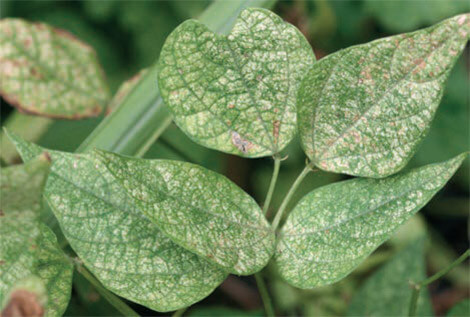
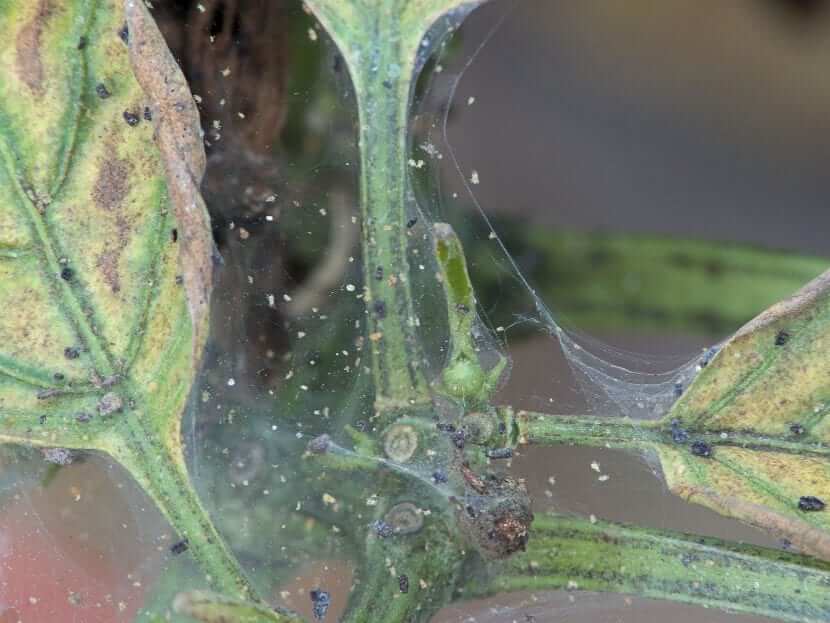
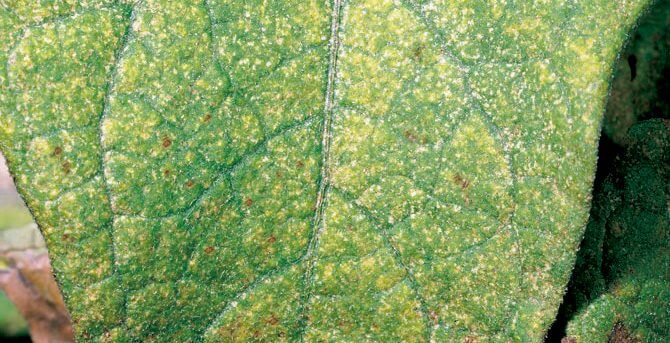
Infestation by Tetranychus urticae in plants causes the disease known as red spider, which weakens and severely damages plants. These mites feed by sucking the cellular contents of the leaves, which reduces the photosynthetic capacity and causes considerable stress in the plants. Symptoms of this disease include:
- Appearance of yellow or tan Taches on the leaves.
- Discolored and dry leaves.
- Mottled or spotted leaf tissues.
- Premature loss of leaves.
- Reduction of plant vigor and growth.
- Presence of fine cobwebs on the underside of the leaves and between the shoots.
- Visible damage to shoots and fruits, especially in cases of severe infestations.


TEMPERATURE AND HUMIDITY
20°C - 30°C
40% - 60%

HOW IS IT SPREAD?
Wind, contaminated garden tools, direct contact between plants, exchange of infected plants, flying insects

HOW TO REMOVE IT?
Home remedies
There are no home treatments
Chemical treatments
• ABAMECTIN 1.8% [EC] P/V
• RAPE OIL 1.53% [AL] P/V
• RAPE OIL 848.24 g/l [EC] P/V
• ORANGE OIL 60g/L [ME] P/S
• PARAFFIN OIL (CAS [97862-82-3]) 80% [EC] P/V
• SULFUR 80% [SC] P/V
• SULFUR 80% [WG] P/P
• SULFUR 80% [WP] P/P
• BIPHENAZATE 24% [SC] P/V
• PHENPIROXIMATE 5.12% [SC] P/V
• HEXITIAZOX 10% [WP] P/P
• MILBEMECTIN 0.93% [EC] P/V
• POTASSIUM SALTS OF UNSATURATED FATTY ACIDS C7-C18 & C18 (CAS [67701-09-1] 515g/L [SL] P/V
• POTASSIUM SALTS OF UNSATURATED FATTY ACIDS C7-C18 & C18 10.2g/L [AL] P/V
• TAU-FLUVALINATE 24% [EW] P/V
Authorized treatments in organic farming
• RAPE OIL 1.53% [AL] P/V
• RAPE OIL 848.24 g/l [EC] P/V
• ORANGE OIL 60g/L [ME] P/S
• PARAFFIN OIL (CAS [97862-82-3]) 80% [EC] P/V
• SULFUR 80% [SC] P/V
• SULFUR 80% [WG] P/P
• SULFUR 80% [WP] P/P
• POTASSIUM SALTS OF UNSATURATED FATTY ACIDS C7-C18 & C18 (CAS [67701-09-1] 515g/L [SL] P/V
• POTASSIUM SALTS OF UNSATURATED FATTY ACIDS C7-C18 & C18 10.2g/L [AL] P/V
Insect allies
PREDATORY MITES
LADYBUGS
LACEWINGS
PARASITIC WASPS
HOVERFLIES OR PARASITIC FLIES
PREDATORY BUGS
There are no natural allies
Mycodiplosis oidii (predatory mosquito)
EFFECTIVE PRODUCTS TO ELIMINATE THIS DISEASE
Sponsored link
Sponsored link


Sponsored link
Sponsored link
Sponsored link


Sponsored link
Sponsored link
Effective against all types of fungi

Sponsored link


Sponsored link
Sponsored link

Sponsored link


Sponsored link
- Regularly monitor plants for the presence of mites.
- Use horticultural oils and insecticidal soaps to suffocate and eliminate mites.
- Introduce and encourage the presence of natural enemies such as predatory mites (Phytoseiulus persimilis).
- Maintain adequate ventilation and humidity in the crop to discourage the development of red spiders.
- Apply balanced irrigation and fertilization to keep plants vigorous and less susceptible to infestations.
- Use sticky traps to monitor the presence of flying mites.
- Carry out crop rotations to interrupt the life cycle of the red spider.
- Implement preventive phytosanitary treatments during times of greatest risk.
- Prune and remove infested parts of the plant to reduce the mite population.
- Avoid excessive use of nitrogen fertilizers, which can promote the growth of red spider mites.
Recommendations

Enjoy idMicrobe TOTALLY FREE, with no trial periods.


