top of page

Frutos

How to recognize the damage caused by excessive sun exposure to fruit

Excessive sun

Environmental stress

Type:

Risk to the plant:

INTERMEDIATE

-

Pathogen:
How to recognize the damage caused by excessive sun exposure to fruit

Estrés ambiental

CTA superior EN.webp
1709890758744.png

WHO CAUSES IT?

Sunburn, or excessive sun exposure, is a physiological disorder of fruit caused by overexposure of fruit tissues to solar radiation, especially when the surface temperature rises considerably above the air temperature. Direct solar radiation, particularly ultraviolet and infrared radiation, can cause a significant increase in the temperature of exposed tissues and damage to the cells of the epidermis and surface layers of the fruit. The risk increases when fruit that was normally protected by leaves is suddenly exposed due to pruning, leaf fall, defoliation, wind, water stress, or changes in fruit orientation. The exposed tissues can reach temperatures well above the ambient temperature, especially during the hottest hours of the day and under conditions of high radiation. When the surface temperature exceeds the tissue's tolerance capacity, alterations of cell membranes, protein denaturation, loss of cell function, and, in the most severe cases, localized tissue death occur. The damage can appear rapidly and does not require the presence of any infectious organism. Susceptibility depends on the species, variety, color and characteristics of the epidermis, stage of ripeness, water content, prior sun exposure, and the fruit's ability to dissipate heat. Green or immature fruits may exhibit different susceptibility than those nearing maturity, while certain varieties with darker skin may heat up more quickly. Water stress significantly increases the risk because it reduces the availability of water for transpiration and natural tissue cooling. Similarly, a sudden loss of leaf cover can expose unacclimated fruits to intense radiation. There is no infection, reproduction, or spread of a causal organism; therefore, the problem does not involve a biological transmission process and cannot spread between fruits like an infectious disease.

1713099015053 (2).png

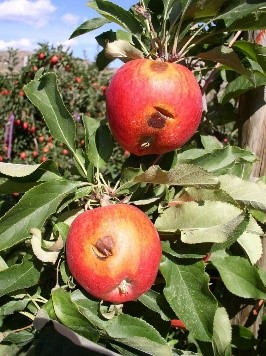
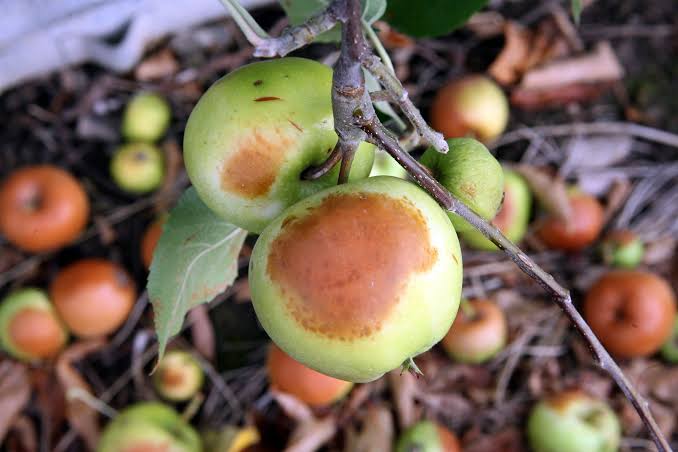
SYMPTOMS

Excessive sun exposure causes localized damage to fruit in areas directly exposed to intense sunlight. Initially, discoloration or loss of the normal color of the epidermis may be observed, followed by a change to yellowish, whitish, reddish, or brownish tones, depending on the species and stage of ripeness. As the damage increases, the affected areas may become dry, hardened, or slightly sunken and clearly demarcated from healthy tissue. In cases of very intense exposure, surface cells may die and form necrotic areas that subsequently dehydrate and acquire a leathery texture. The damage is usually located primarily on the side of the fruit facing the sun and can be more severe in areas that have been suddenly exposed due to leaf loss. The lesions can reduce the commercial value of the fruit and, when extensive, affect its quality and shelf life. The damaged areas can also subsequently facilitate the entry of certain opportunistic microorganisms, although sunburn itself is not caused by fungi, bacteria, or other pathogens. In sensitive fruits, the combination of high radiation, high temperatures, and water deficit can intensify dehydration and promote the appearance of more serious surface damage. Browning / Spots / Sunken spots / Dehydration / Tissue drying / Surface necrosis / Loss of color / Skin hardening
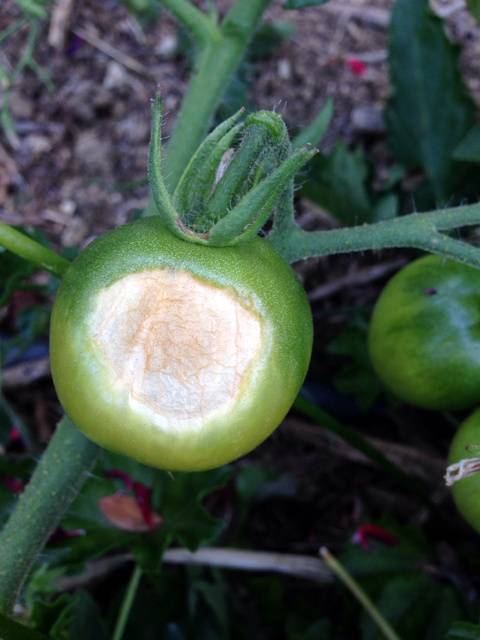
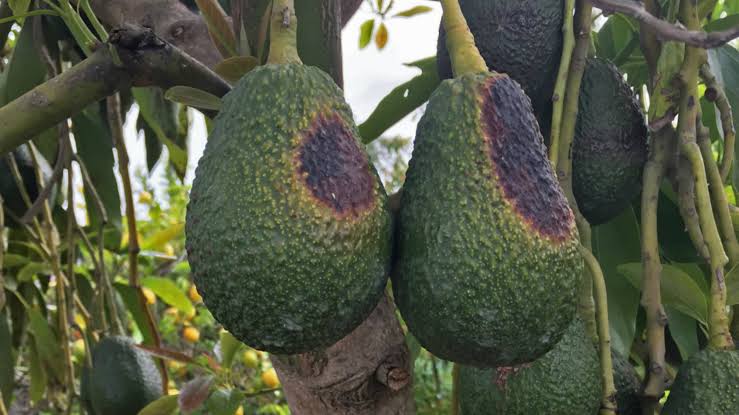
Excessive sun exposure in fruit: how to recognize and effectively treat it
Fruit with sunburn and areas damaged by excessive sun exposure
Excessive sun exposure in plants: symptoms and visible damage to fruit
CTA medio EN.webp
pronostica_edited.png

DEVELOPMENT CONDITIONS

Temperature:

-

Humidity:

-

1709890758697.png

HOW IS IT SPREAD?

-

1709890758673.png

HOW TO ELIMINATE IT?

Home treatments

BONE MEAL OR GROUND FISH SHELLS

RUSTY NAILS OR IRON SHAVINGS

BANANA PEELS

EPSOM SALTS (MAGNESIUM SULFATE)

SOLUTION WITH HOUSEHOLD BORAX

GROUND OR BOILED EGGSHELLS

COMPOST WITH ONION OR GARLIC SCRAPS

VEGETABLE COOKING WATER

WOOD ASH

WATER WITH VINEGAR OR LEMON (VERY DILUTED)

GARLIC INFUSION

USED COFFEE OR TEA

BANANA AND EGGSHELL INFUSION

POTATO OR LEGUME COOKING WATER

COMPOST FROM FRESH GREEN LEAVES

COMPOST OR WELL-AGED MANURE

DILUTED MILK (1:10)

BANANA TEA

LEAF COMPOST

NETTLE SLURRY

POTASSIUM SOAP AND NEEM OIL SOLUTION

POTASSIUM SOAP SOLUTION + NEEM OIL + DIATOMACEOUS EARTH

BAKING SODA AND NEUTRAL SOAP SOLUTION

GARLIC INFUSION WITH NEUTRAL SOAP

CHROMATIC OR ADHESIVE TRAPS

DILUTED MILK

HORSETAIL INFUSION

TRUNK WHITEWASHING

DIATOMACEOUS EARTH

WOOD ASH

NETTLE SLURRY

CUT THE AFFECTED BRANCHES AND APPLY CINNAMON

GARLIC AND CINNAMON INFUSION

INFUSION OF WORMWOOD, CHILI OR CHILLI

CLEAN THE AFFECTED AREA AND APPLY ASH PASTE WITH GARLIC OR CINNAMON

GARLIC AND MINT INFUSION

LIGHT TRAPS

APPLY CINNAMON POWDER

PITFALL TRAPS

CRUSHED EGG SHELLS

CLEAN AND SEAL THE WOUND WITH CLAY, CINNAMON AND GARLIC PASTE

GARLIC INFUSION

MATURE COMPOST

TRAPS WITH VINEGAR AND SOAP

SEAL HOLES WITH ASH PASTE AND CRUSHED GARLIC

VINEGAR AND BAKING SODA SOLUTION

ANT TRAP

TAPE TRAP

PHEROMONE TRAP

ALCOHOL TRAPS

FUNNEL TRAP

There are no home treatments

Natural allies

PREDATORY MITES

LADYBUGS

LACEWINGS

PARASITIC WASPS

HOVERFLIES OR PARASITIC FLIES

PREDATORY BUGS

There are no natural allies

Mycodiplosis oidii (predatory mosquito)

Chemical treatments

AGRICULTURAL SULFUR (POWDER OR SOLUBLE)

POTASSIUM FERTILIZERS

MAGNESIUM FERTILIZERS

BORON FERTILIZERS

CALCIUM FERTILIZERS

NITROGEN FERTILIZERS

PHOSPHORUS FERTILIZERS

IRON FERTILIZERS

SULFUR FERTILIZERS

NPK FERTILIZERS

There are no treatments for this disease. Treatments are directed at the insect vectors that transmit it. See insect treatments.

ABAMECTIN 0.0015% + PYRETHRINS 0.02%

RAPESEAL OIL

RAPESEAL OIL + PYRETHRINS

ORANGE OIL 6%

PARAFFIN OIL

ACETAMIPRID

ACETAMIPRID 0.005%

ACETAMIPRID 20%

SULFUR

COPPER 20%

COPPER 25%

COPPER 35%

COPPER 38%

COPPER 50%

COPPER 52%

DELTAMETHRIN 1.57%

DELTAMETHRIN 10%

DELTAMETHRIN 2.5%

DIFENOCONAZOLE 1.67%

ESFENVALERATE 2.5%

ESFENVALERATE 5%

100% GARLIC EXTRACT

PHENHEXAMIDE 50%

FLUPYRADIFURONE

FLUPIRADIFURONE 20%

FOSETIL-AL 80%

FERRIC PHOSPHATE

ALUMINUM PHOSPHIDE 56%

PHOSTIAZATE 10%

PHOSTIAZATE 15%

HEXITIAZOX 10%

POTASSIUM HYDROGEN CARBONATE

LAMBDA CYHALOTHRIN

LAMINARIN 4.5%

METALDEHYDE

PIRACLOSTROBIN 6.7% + BOSCALIDE 26.7%

PYRETHRINS

PYRIPROXIFEN 10%

POTASSIUM SALTS OF UNSATURATED FATTY ACIDS

SPINOSAD 0.024%

SPINOSAD 12%

SPINOSAD 48%

TAU-FLUVALINATE 24%

TETRACONAZOLE 10%

TETRACONAZOLE 12.5%

TETRACONAZOLE 4%

TRICHODERMA ASPERELLUM (STRAIN T34)

RECOMMENDED PRODUCTS TO ELIMINATE THE PEST

Sponsored link

Ecoworm Potassium Soap

Ecoworm Potassium Soap

Multi-purpose solution for insects. Effective against whiteflies, mites, thrips, leafhoppers, aphids and scale insects.

Sponsored link

Fruit Fly Traps

Fruit Fly Traps

Ready-to-use fruit fly trap with attractant.

Sponsored link

Liquid Copper Fungicide

Liquid Copper Fungicide

Copper fungicide for fungal diseases and plant diseases.

Sponsored link

Organic Seaweed Fertiliser

Organic Seaweed Fertiliser

Plant Food Ideal for All Plants, Rich in Additional Nutrients

Sponsored link

Fungus Fighter Plus | Fungicide for Plants

Fungus Fighter Plus | Fungicide for Plants

Broad-spectrum fungicide for effective control of fungal diseases in plants.

Sponsored link

Ultimate Bug Killer | Broad-Spectrum Insecticide

Ultimate Bug Killer | Broad-Spectrum Insecticide

Fast acting bug spray with up to 2 weeks protection, controls common garden pests

1714749024044.png

REPELLENT PLANTS

​

1709890758720.png

RECOMMENDATIONS

​

OTHER PESTS THAT MAY INTEREST YOU

THE MOST POPULAR

How to prepare baking soda to remove sooty mold

How to use baking soda to remove sooty mold

How to make sticky traps to eliminate whiteflies on your plants

How to control whiteflies with yellow sticky traps

Home remedies to eliminate snails and slugs from plants

5 home remedies to combat snails and slugs

How to prepare homemade nettle slurry to eliminate whiteflies

How to use nettle slurry to eliminate whiteflies

DID YOU LIKE IT?

Now you can always have it on your mobile, without ads and totally FREE. TRY idMicrobe NOW!

button_google_play_EN.png
boton_mobile_Version_EN.jpg
bottom of page