


Symptoms, treatments, and recommendations for treating white rot
White Rot
Sclerotium Cepivorum
Pathogen:
Type:
Fungus
Risk:
HIGH

Ajo
Moho blanco

WHO CAUSES IT?
Sclerotium cepivorum is a fungal pathogen that primarily affects garlic plants, causing a devastating disease known as white rot. This organism belongs to the Sclerotiniaceae family and is characterized by the formation of resistance structures called sclerotia, which can remain viable in the soil for several years. Sclerotia germination is stimulated by specific compounds exuded by garlic roots, which initiates infection. The fungus invades the roots and neck of the plant, producing white mycelium that spreads through the tissues. As the infection progresses, the fungus continues to develop and colonize the tissues, eventually producing new sclerotia that fall to the ground and restart the infectious cycle.

SYMPTOMS
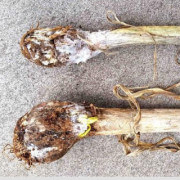
White rot caused by Sclerotium cepivorum is one of the most destructive diseases of garlic crops. Initial symptoms include yellowing and wilting of leaves, followed by collapse of the entire plant. As the disease progresses, a soft, watery rot is observed on the roots and bulb, which eventually becomes covered with a dense white mycelium. This mycelium is indicative of the presence of sclerotia that perpetuate the infection.
- Yellow and withered leaves
- Plant collapse
- Water rot in roots and bulb
- White mycelium on the roots and bulb
- Presence of sclerotia in the soil.


TEMPERATURE AND HUMIDITY
15-25°C
60-80%

TRANSMISSION PATHS
Sclerotia in soil, contaminated tools, infected planting material, irrigation water, infected plant remains
Do you want to remove this disease? Choose how you want to treat it.

TREATMENTS
Chemical treatment
• AZOXISTROBIN 20% + DIFENOCONAZOLE 12.5% [SC] P/V
• AZOXISTROBIN 25% [SC] P/V
• CIPRODINIL 37.5% + FLUDIOXONIL 25% [WG] P/P
• DIFENOCONAZOLE 25% [EC] P/V
• FLUOPYRAM 20% + TEBUCONAZOLE 20% [SC] P/V
• FLUXAPYROXAD 7.5% + DIFENOCONAZOLE 5% [SC] P/V
• PIRACLOSTROBIN 6.7% + BOSCALIDE 26.7% (I) [WG] P/P
• TEBUCONAZOLE 20% [EC] P/V
• TEBUCONAZOLE 20% [EW] P/V
• TEBUCONAZOLE 25% [EW] P/V
• TEBUCONAZOLE 25% [WG] P/P
Authorized treatments in organic farming
-
Biological control
• BACILLUS AMYLOLIQUEFACIENS (MBI 600 strain) 11% [WP] P/P
• BACILLUS AMYLOLIQUEFACIENS (subsp. plantarum, strain D747) 25% [WG] P/P
• BACILLUS AMYLOLIQUEFACIENS subsp. plantarum (strain D747) 5% [SC] P/V
• PYTHIUM OLIGANDRUM (strain M1) 17.5% [WP] P/P
• TRICHODERMA ASPERELLUM (STRAIN T25) (1X10E8 CFU/G) 0.5% + TRICHODERMA ATROVIRIDE (STRAIN T11) (1X10E8 CFU/G) 0.5% [WG] P/P
• TRICHODERMA ASPERELLUM (STRAIN T34) 12% (1.0 x 10E12 cfu/kg) [WP] P/P
• Trichoderma atroviride strain SC1 1(1 x 10E10 cfu)/g [WG] P/P
• TRICHODERMA ATROVIRIDE (STRAIN I-1237) (1x10E8 cfu/g) 5% [WP] P/P
Recommendations
- Crop rotation with non-host plants to reduce the load of sclerotia in the soil.
- Use of pathogen-free seeds and bulbs to avoid the introduction of Sclerotium cepivorum.
- Application of soil disinfection treatments, such as solarization or fumigation with chemical agents.
- Implementation of agricultural management practices that improve soil drainage and reduce humidity around plants.
- Use of specific fungicides to control sclerotia in the early stages of infection.
- Regular monitoring of the crop and elimination of infected plants to prevent the spread of the fungus.





*The recommended treatments are still recommendations according to the databases of the authorities and at no time do they replace the guidelines established according to the legislation of each country
*The products shown are recommendations and are not our own products. As Amazon Associates, we earn revenue from purchases of recommended products.

TREATMENTS
Homemade treatments
There are no home treatments
Natural allies
Chemical treatments
There are no treatments for this disease. Treatments are directed at the insect vectors that transmit it. See insect treatments.

RECOMMENDATIONS

REPELLENT PLANTS
RECOMMENDED PRODUCTS TO ELIMINATE THIS PEST
*The recommended treatments are still recommendations according to the databases of the authorities and at no time do they replace the guidelines established according to the legislation of each country
*The products shown are recommendations and are not our own products. As Amazon Associates, we earn revenue from purchases of recommended products.



Explore more tools
Services
Contact
Legal
©2023 by ZeriMar Laboratoire. All rights reserved.