


Symptoms, treatments and recommendations for treating powdery mildew
Powdery Mildew
Sphaerotheca Pannosa / Podosphaera Tridactyla
Pathogen:
Type:
Fungus
Risk:
INTERMEDIATE

Albaricoque
Oídio


WHO CAUSES IT?
Sphaerotheca pannosa and Podosphaera tridactyla are two species of fungi that cause the disease known as powdery mildew on a variety of plants, including apricot (Prunus armeniaca). These pathogens are responsible for causing white, powdery-looking Taches on the leaves, stems and fruits of apricot trees, which negatively affects their health and yield.

SYMPTOMS
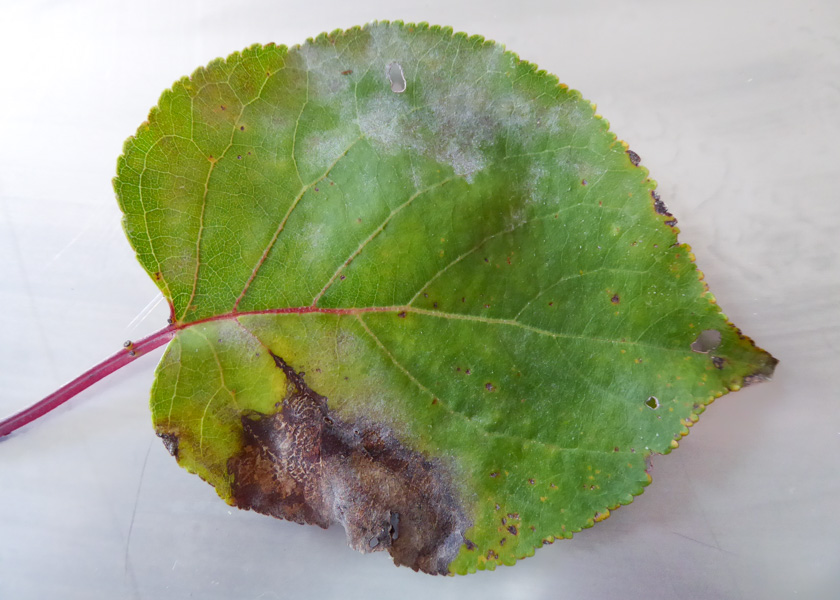
Powdery mildew disease in apricot initially manifests itself as white, powdery-looking Taches on the upper part of the leaves, which can then spread to the stems and fruits. As the disease progresses, these Taches can merge and cover large areas of the plant, reducing the capacity for photosynthesis and weakening the plant overall.


TEMPERATURE AND HUMIDITY
15ºC - 25ºC
50% - 90%

TRANSMISSION ROUTES
Wind-borne spores, direct contact, contaminated agricultural tools, contaminated irrigation water, infected plant material, infected seeds.
Do you want to remove this disease? Choose how you want to treat it.

TREATMENTS
Chemical treatments
• ORANGE OIL 6% [SL] P/V
• ORANGE OIL 60g/L [ME] P/S
• SULFUR 70% [SC] P/V
• SULFUR 72% [SC] P/V
• SULFUR 80% [SC] P/V
• SULFUR 80% [WG] P/P
• SULFUR 80% [WP] P/P
• SULFUR 82.5% [SC] P/V
• BUPIRIMATE 25% [EC] P/V
• CIFLUFENAMID 5.13% [EW] P/V
• DIFENOCONAZOLE 25% [EC] P/V
• FLUOPYRAM 20% + TEBUCONAZOLE 20% [SC] P/V
• FLUXAPYROXAD 30% [SC] P/V
• POTASSIUM HYDROGEN CARBONATE 0.425% [AL] P/V
• POTASSIUM HYDROGEN CARBONATE 85% [SP] P/P
• Penconazole 10% [EC] P/V
• PENCONAZOLE 20% [EW] P/V
• PIRACLOSTROBIN 6.7% + BOSCALIDE 26.7% ( ) [WG] P/P
• PIRACLOSTROBIN 6.7% + BOSCALIDE 26.7% [WG] P/P
• TEBUCONAZOLE 20% [EW] P/V
• TEBUCONAZOLE 25% [EC] P/V
• TEBUCONAZOLE 25% [EW] P/V
• TEBUCONAZOLE 25% [WG] P/P
• TEBUCONAZOLE 50% + TRIFLOXISTROBIN 25% [WG] P/P
Authorized treatments in organic farming
• ORANGE OIL 6% [SL] P/V
• ORANGE OIL 60g/L [ME] P/S
• SULFUR 70% [SC] P/V
• SULFUR 72% [SC] P/V
• SULFUR 80% [SC] P/V
• SULFUR 80% [WG] P/P
• SULFUR 80% [WP] P/P
• SULFUR 82.5% [SC] P/V
• POTASSIUM HYDROGEN CARBONATE 0.425% [AL] P/V
• POTASSIUM HYDROGEN CARBONATE 85% [SP] P/P
Biological control
• BACILLUS AMYLOLIQUEFACIENS (subsp. plantarum, strain D747) 25% [WG] P/P
• BACILLUS SUBTILIS (STRAIN QST 713) 1.34% [SC] P/V
Recommendations
To prevent and control powdery mildew in apricot, it is essential to implement integrated pest management practices. This includes removing infected leaves and branches, proper pruning to improve air circulation and reduce humidity, and applying specific fungicides preventatively. In addition, maintaining an adequate level of fertilization and avoiding water stress can help strengthen the trees' resistance to powdery mildew.





*Recommended treatments are still recommendations according to authority databases and in no way replace the guidelines established according to the legislation of each country.
*Products shown are recommendations and not our own products. As Amazon Associates, we earn revenue from purchases of recommended products.

TREATMENTS
Homemade remedies
There are no home treatments
Natural allies
Chemical treatments
There are no treatments for this disease. Treatments are directed at the insect vectors that transmit it. See insect treatments.

RECOMMENDATIONS

REPELLENT PLANTS
EFFECTIVE PRODUCTS TO ELIMINATE THIS DISEASE
*Recommended treatments are still recommendations according to authority databases and in no way replace the guidelines established according to the legislation of each country.
*Products shown are recommendations and not our own products. As Amazon Associates, we earn revenue from purchases of recommended products.



Explore more tools
Services
Contact
Legal
©2023 por ZeriMar Laboratoire. Todos os direitos reservados.