


Symptoms, treatments and recommendations for treating oriental moth
Eastern Moth
Grapholita Molesta
Pathogen:
Type:
Insect
Risk:
HIGH
Albaricoque
Polillas


WHO CAUSES IT?
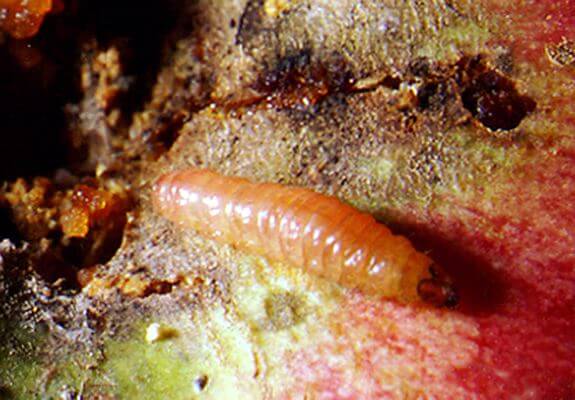
The eastern moth, whose scientific name is Grapholita molesta, is an insect of the Tortricidae family that mainly affects apricots. This insect has a life cycle that begins when the adult female lays her eggs in the fruits of the apricot tree. The larvae emerge from the eggs and penetrate the fruits, where they feed and develop. Once their larval cycle is complete, the larvae emerge from the fruits and head towards the ground, where they pupate. After a period of pupation, adult moths emerge and the cycle repeats. This cycle can occur several times during the growing season, depending on environmental conditions and food availability.

SYMPTOMS
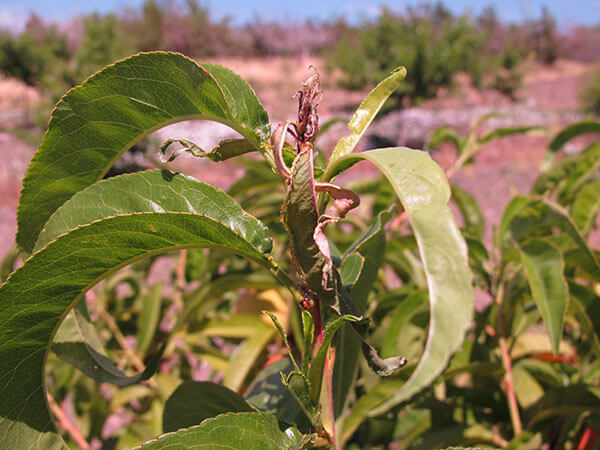
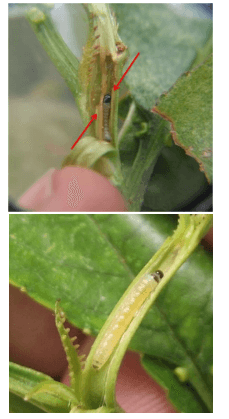
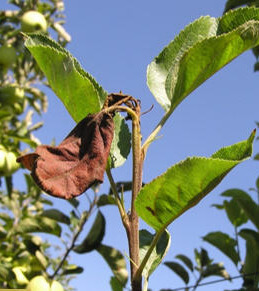
The infestation of the oriental moth in the apricot tree causes significant damage to the fruits, resulting in the reduction of the quality and quantity of the harvest. General symptoms of infestation include the presence of entry holes in the fruits, larval excrement inside the fruits, and the presence of larvae inside the fruits.
- Entry holes in the fruits
- Larval excrement inside the fruits
- Larvae present inside the fruits
- Decay and rot of infested fruits
- Loss of quality and quantity of the harvest
- Aesthetic damage to the fruits


TEMPERATURE AND HUMIDITY
20-30°C
60-80%

TRANSMISSION ROUTES
Movement of adult moths, Transport of infested fruits, Natural dispersal of larvae, Contamination of tools and equipment
Do you want to remove this disease? Choose how you want to treat it.

TREATMENTS
Chemical treatments
• (E)-5-DECEN-1-OL 1.1% (5.4mg/diffuser) + (E)-5-DECEN-1-YL ACETATE 18.7% (92.2mg/diffuser) + E- 8-DODECENYLACETATE 2.2% (10.7mg/diffuser) + Z-8-dodecen-1-ol 0.3% (1.3mg/diffuser) + Z-8-DODECENYLACETATE 33.4% (164.8mg/diffuser) diffuser) [VP] P/P
• (E)-5-DECEN-1-YL ACETATE 17.48% + (E)-5-DECEN-1-OL 3.63% + MIXTURE OF (E)-8-DODECEN-1-YL ACETATE + ( Z)-8-DODECEN-1-YL ACETATE + (Z)-8-DODECEN-1-OL 12.5% [AE] P/P
• (Z)-8-DODECEN-1-YL ACETATE 76 g/Kg + (E)-8-DODECEN-1-YL ACETATE 4.8 g/Kg + (Z)-8-DODECEN-1-OL 0, 8 g/Kg [AE] P/P
• ACETAMIPRID 20% [SL] P/V
• (E/Z)-8-dodecen-1-yl acetate 96.2 g/Kg + 51 g/Kg of the mixture of (E)-5-decen-1-yl acetate and (E)-5- decen-1-ol + n-hexadecyl acetate 35.6 g/Kg (1050 mg s.a./diffuser) [VP] P/P
• (Z)-8-DODECEN-1-YL ACETATE 4.65% + (E)-8-DODECEN-1-YL ACETATE 0.3% + Z-8-dodecen-1-ol 0.05% [VP] P/P
• CHLORANTRANILIPROL 20% [SC] P/V
• DELTAMETHRIN 1.57% [SC] P/V
• DELTAMETHRIN 10% [EC] P/V
• DELTAMETHRIN 2.5% [EC] P/V
• DELTAMETHRIN 2.5% [EW] P/V
• Annoying grapholite (Pheromone)
• LAMBDA CYHALOTHRIN 1.5% [CS] P/V
• LAMBDA CYHALOTHRIN 10% [CS] P/V
• LAMBDA CYHALOTHRIN 2.5% [WG] P/P
• Mixture of (E)-8-Dodecen-1-yl acetate + (Z)-8-Dodecen-1-yl acetate + (Z)-8-Dodecen-1-ol [AE] P/V
• MIXTURE OF (E/Z)-8-DODECEN-1-YL ACETATE + (Z)-8-DODECEN-1-OL 10% [CS] P/P
• MIXTURE OF (Z,E)-8-DODECEN-1-YL ACETATE + (Z)-8-DODECEN-1-OL 0.358 g/diffuser [VP] P/P
• SPINETORAM 25% [WG] P/P
Authorized treatments in organic farming
• (E)-5-DECEN-1-OL 1.1% (5.4mg/diffuser) + (E)-5-DECEN-1-YL ACETATE 18.7% (92.2mg/diffuser) + E- 8-DODECENYLACETATE 2.2% (10.7mg/diffuser) + Z-8-dodecen-1-ol 0.3% (1.3mg/diffuser) + Z-8-DODECENYLACETATE 33.4% (164.8mg/diffuser) diffuser) [VP] P/P
• (E)-5-DECEN-1-YL ACETATE 17.48% + (E)-5-DECEN-1-OL 3.63% + MIXTURE OF (E)-8-DODECEN-1-YL ACETATE + ( Z)-8-DODECEN-1-YL ACETATE + (Z)-8-DODECEN-1-OL 12.5% [AE] P/P
• (Z)-8-DODECEN-1-YL ACETATE 76 g/Kg + (E)-8-DODECEN-1-YL ACETATE 4.8 g/Kg + (Z)-8-DODECEN-1-OL 0, 8 g/Kg [AE] P/P
• Annoying grapholite (Pheromone)
• LAMBDA CYHALOTHRIN 1.5% [CS] P/V
• LAMBDA CYHALOTHRIN 10% [CS] P/V
• LAMBDA CYHALOTHRIN 2.5% [WG] P/P
• Mixture of (E)-8-Dodecen-1-yl acetate + (Z)-8-Dodecen-1-yl acetate + (Z)-8-Dodecen-1-ol [AE] P/V
• MIXTURE OF (E/Z)-8-DODECEN-1-YL ACETATE + (Z)-8-DODECEN-1-OL 10% [CS] P/P
• MIXTURE OF (Z,E)-8-DODECEN-1-YL ACETATE + (Z)-8-DODECEN-1-OL 0.358 g/diffuser [VP] P/P
Biological control
• BACILLUS THURINGIENSIS AIZAWAI 50% [WG] P/P
• BACILLUS THURINGIENSIS KURSTAKI (ABTS-351 strain, 640 g/kg) (32 MILLION CLU/g) 64% [WP] P/P
• BACILLUS THURINGIENSIS KURSTAKI (ABTS-351 strain) (32 MILLION CLU/g) 54% (540 g/kg) [WG] P/P
• BACILLUS THURINGIENSIS KURSTAKI (ABTS-351 strain) (32 MILLION CLU/g) 54% [WG] P/P
• BACILLUS THURINGIENSIS KURSTAKI (ABTS-351 strain) 54[WG] P/P
• BACILLUS THURINGIENSIS KURSTAKI (Strain EG 2348) 22.6% (24 x 10E6 UI/g) [SC] P/V
• BACILLUS THURINGIENSIS KURSTAKI (STRAIN PB 54) (16x10E6 I.U./G) 8% [WP] P/P
• BACILLUS THURINGIENSIS KURSTAKI (STRAIN PB 54) (16x10E6 IU/G) 9.74% [SC] P/V
• BACILLUS THURINGIENSIS KURSTAKI (STRAIN PB 54) 32% (32 MILLION IU/G) [WP] P/P
• BACILLUS THURINGIENSIS KURSTAKI (Strain SA-11) 85% (32 MILLION IU/G) [WG] P/P
• BACILLUS THURINGIENSIS KURSTAKI (EG 2348) (24x106 I.U./G) 18.3% [SC] P/V
• BACILLUS THURINGIENSIS KURSTAKI (EG 2348) 37.5% [WP] P/P
• CYDIA POMONELLA GRANULOVIRUS (MEXICAN ISOLATE) 90.9% (1X10e13 GRANULES/L) [SC] P/V
• CYDIA POMONELLA GRANULOVIRUS (R5 ISOLATE) 90.9% (1 X 10E13 GV/L) [SC] P/V
• CYDIA POMONELLA GRANULOVIRUS (CpGV V22) (3 X 10E13 GRANULES/L) 52% [SC] P/V
• STEINERNEMA FELTIAE (Parasitoid and predatory nematodes)
Recommendations
- Install pheromone traps to monitor the presence and density of the eastern moth.
- Carry out sanitary pruning to eliminate infested fruits and reduce the insect population.
- Use protective mesh on trees to prevent the entry of adults and oviposition.
- Apply specific insecticides at key moments in the moth's life cycle, following integrated pest management recommendations.
- Implement appropriate cultural practices, such as the elimination of weeds and crop remains, to reduce refuges and reproduction of the insect.
- Promote the presence of natural enemies of the eastern moth, such as parasitoid wasps and insectivorous birds.





*Recommended treatments are still recommendations according to authority databases and in no way replace the guidelines established according to the legislation of each country.
*Products shown are recommendations and not our own products. As Amazon Associates, we earn revenue from purchases of recommended products.

TREATMENTS
Homemade remedies
There are no home treatments
Natural allies
Chemical treatments
There are no treatments for this disease. Treatments are directed at the insect vectors that transmit it. See insect treatments.

RECOMMENDATIONS

REPELLENT PLANTS
EFFECTIVE PRODUCTS TO ELIMINATE THIS DISEASE
*Recommended treatments are still recommendations according to authority databases and in no way replace the guidelines established according to the legislation of each country.
*Products shown are recommendations and not our own products. As Amazon Associates, we earn revenue from purchases of recommended products.



Explore more tools
Services
Contact
Legal
©2023 por ZeriMar Laboratoire. Todos os direitos reservados.